By Ray Bradbury (August 22, 1920 – June 5, 2012) The short story “There Will Come Soft Rains” by Ray Bradbury gets its name from a poem written by Sara Teasdale (August 8, 1884 – January 29, 1933) in 1918. Written during the first World War, the poem describes a serene and idyllic world in which nature peacefully and indifferently reclaims the world after mankind destroys itself in the fighting.
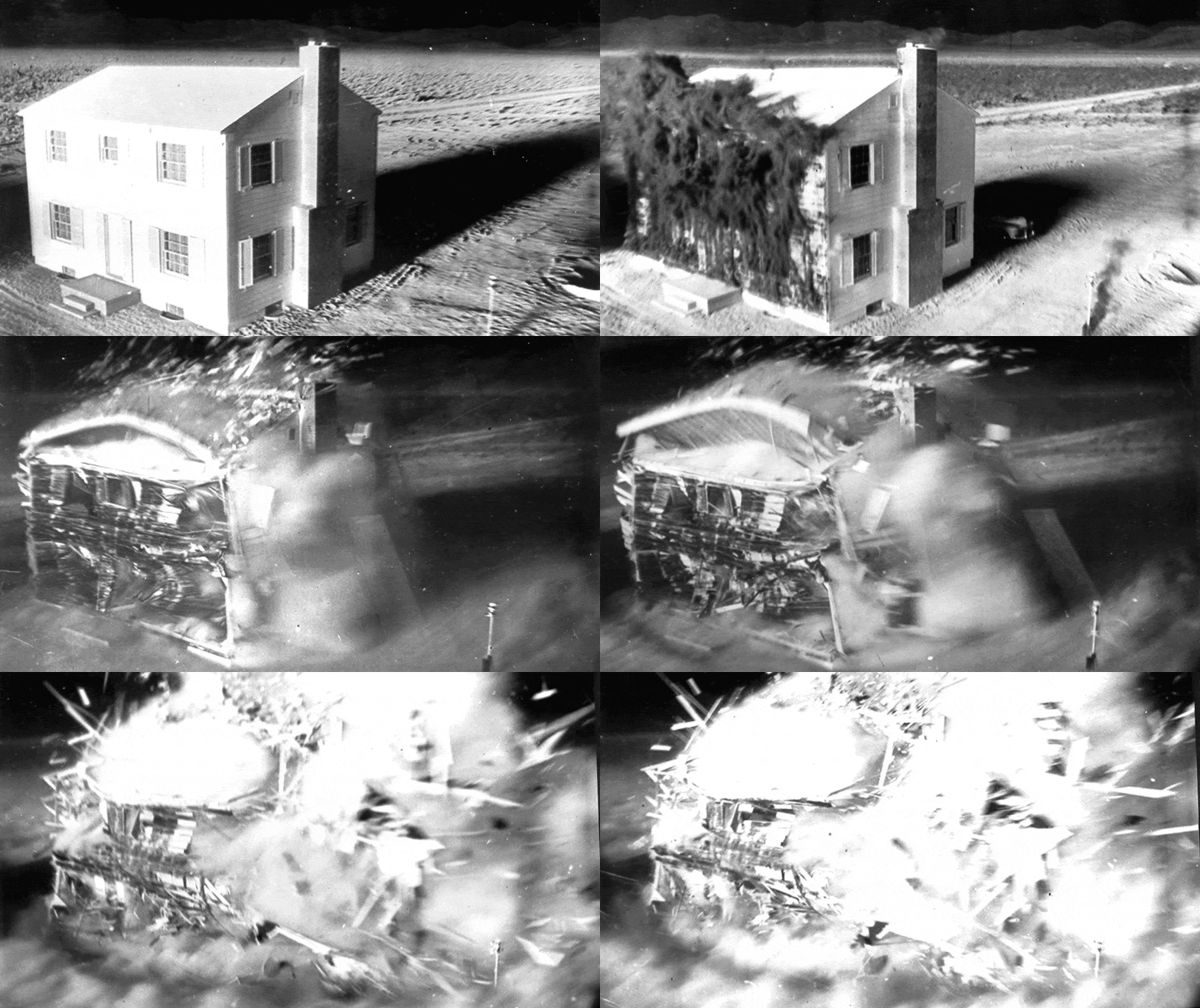
Ray Bradbury wrote “There Will Come Soft Rains” in 1950, only five years after the bombing of Hiroshima and Nagasaki in the Second World War. In the story, a house robotically performs daily tasks, making breakfast, cleaning floors, heating beds, and reading poetry to a family that was supposedly killed in a nuclear blast. Their shadows—a man mowing grass, a woman picking flowers, and children playing with a ball—are burned into a wall of the house. The only true survivors of the blast (other than the family dog, who dies to what is most likely radiation poisoning or starvation) are the robotic voices of the house: the singing voice announcing the time, the robotic cleaning mice and other machinery performing tasks in the home. They, too, inevitably die. When a fire catches, the house burns, panicking, crying out for help, and frantically performing tasks, before it is reduced to ash and smoke. Still, one wall stands, singing out the date in a voice that will never be heard.
Sara Teasdale’s original anti-war poem was full of peaceful imagery, including singing frogs, circling swallows, and wild white plum trees (Teasdale 238). These gentle couplets give the poem a feeling of romanticism, serenity, and hope. Bradbury’s story, however, shows the omnipresent fear of a nuclear holocaust that existed in the wake of World War II. While the house performs its tasks, Bradbury describes a neighborhood of rubble and ash which, “At night… gave off a radioactive glow which could be seen for miles,” (Bradbury 34). The shadows of the McClellan family, preserved on the wall of the home, evoke the shadows of the vaporized population of Hiroshima, burned forever in ordinary moments. Bradbury lived in a time that Teasdale could never imagine, one in which the creation of the nuclear bomb solidified a fear of a future where nothing is left. The difference between these times was the advancement technology, shaping the world more and more to center the whims of humans over every other creature. Bradbury even describes the house as an “...altar with nine thousand robot attendants… even though the gods had gone away and the ritual was meaningless” (Bradbury 34).
In this sense, Bradbury’s use of Teasdale’s poem turns her peaceful imagery on its head, showing how the advancement of technology has pushed nature away and allowed humans to gain more power over their environments, even to the point of creating and detonating a nuclear bomb.
Bradbury’s story features a fundamental battle between man and nature. Within the context of the conflict, the house acts as a proxy for humanity itself. It is personified throughout the story by its voice: human-like and singsong, a cheerful attendant. Phrases like “…the voice clock sang… Time to get up!’ as if it were afraid that nobody would,” and “how carefully it had asked, ‘Who goes there?’” suggest to the reader that the house is capable of having feelings beyond a pre-recorded message, almost as if it has opinions, hopes, and dreams (Bradbury 34). Bradbury even describes the home as having “…nine thousand robot attendants, big and small, servicing, attending, singing in choirs…” (Bradbury 34). Each robot has its own voice, function, and personality, making the daily activities of the house feel like a community — society in motion, even if it is only robotic. By the same token, the house's attitudes toward the outside world can be seen as the darker side of humanity: a sinister and compassionless entity with need for complete control. Even after humans are gone, the house continues to “[keep] its peace,” demanding responses from wandering animals, shooing away “evil” birds, and sending cleaning mice to discard dust, as well as leaves and mud tracked in by the family dog (Bradbury 34). These controlling attitudes cause the largest divide between Bradbury and Teasdale's works- nature in Bradbury's apocalyptic world could not fare much better than humans in response to the disaster. The remnants of the natural world left in the wake of the bomb are lonely, ill, and hurting, shown by the “lonely foxes and whining cats,” that the house shoes away, as well as the family dog who was bone thin and ridden with sores (Bradbury 34). Eventually, even the dog succumbs to the disaster, as it “[froths], [runs] insanely, [spins] in a circle, biting its tail, and [dies],” (Bradbury 34). This death, most likely due to radiation poisoning and starvation, is a direct result of human interference in the laws of nature and is further punctuated by the survival of the robotic cleaning mice which carry the body away – imitations of nature that were allowed to live among humans due to their proximity to technology. This constant battle of man vs. nature, order vs. disorder, is a critical aspect of the expanse of technology: it gave humans the power to transform their environments, even to the point of total destruction.
In this same analogy, the fire serves to represent the destruction of humanity in the nuclear blast. The quiet line
“At ten o’clock, the house began to die”
brings to mind the leaflets supposedly dropped on Hiroshima and Nagasaki warning citizens of the bomb and therefore their imminent death (Bradbury 34). Listed as part of a routine, the death of the house seems to be part of technology’s natural conclusion — humanity, quite literally, manufactured its own destruction. As the solvent bottle collapses, the bomb ignites, and the house begins to panic, doing a million things at once: first, trying to save itself, then, randomly completing tasks like playing music, reading poetry, slamming doors and umbrellas while also making breakfasts at a “psychopathic rate,” (Bradbury 34). This pure panic is how humans handle grief: some try to avoid it, others try to live a little before the end, and some do things either to calm themselves or to instill a sense of normalcy, such as reading or cooking. Eventually, though, the fire begins to spread, rapidly eating at the house with its Voices cry out for help, melting together in pain. This horrifying imagery is part of what makes the bomb so devastating; those who are not vaporized on the spot are charred beyond recognition or badly burned at the very least, dying slowly as screams melt into a choir of agony. Eventually the screaming stops as the house, like the neighborhood and society as a whole, collapse into a pile of “Smoke and silence,” (Bradbury 34). Still, one voice breaks through the dawn: one remaining wall is left and repeats the date over the ashes (Bradbury 34). It is unclear whether this wall represents survivors of the bomb, the house itself (if the burning truly represents the destruction of the neighborhood), or technology as a whole. Whoever the voice is meant to be, though, it shows that there will always be some remnant of humanity left, slowly crumbling away — the radioactive half-life of a species long gone.
Teasdale’s poem shows a belief that man’s purpose (if it exists at all) is confined within the species itself. Therefore, after the species is gone, there is no war or violence, just nature’s simple order. Bradbury, however, extends this belief with the expansion of technology, allowing human civilization to maintain its control over the world even after humans themselves have gone extinct. This technological control (which allowed humans to play god for far too long) inevitably culminated in the manufacture of humanity's destruction — a horrific, painful death which left technology to tick on like a geiger counter into the endlessness of time. Since Trinity, the world has never been the same: the knowledge of the possibility of nuclear weaponry is a power, and a fear, that the world will not soon forget.