BarefootGenHappiness
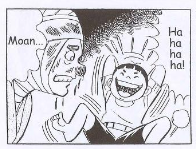
1 media/BarefootGenHappiness_thumb.PNG 2023-12-22T22:49:59+00:00 Aidan York 93781657174eab44f21b0580496f4849573ba124 1 1 An example of cartoonish joy in Barefoot Gen. (Nakazawa, Volume 3, pp. 103) plain 2023-12-22T22:49:59+00:00 Aidan York 93781657174eab44f21b0580496f4849573ba124This page is referenced by:
-
1
media/BarefootGenKey.PNG
2023-12-06T09:41:58+00:00
Barefoot Gen
17
Keiji Nakazawa's semi-autobiographical manga series details the bombing of Hiroshima, and surviving afterwards.
image_header
2023-12-23T18:03:27+00:00
Barefoot Gen, a semi-autobiographical ten-volume manga series, was inspired by author Keiji Nakazawa's (March 14, 1939 — December 19, 2012) own experiences as a survivor of the bombing of Hiroshima. The series tells the story of Gen Nakaoka, who, at the age of 6, loses his father, brother, and sister, to the fires of Hiroshima, closely mirroring Nakazawa's own atomic bombing experiences. In particular, Gen's father was a staunch anti-war advocate and had instilled a longing for peace and a disdain of the militarism of Japan into his son. After the bombing and the complete annihilation of their old way of life, Gen and his mother spend the early parts of the series looking for a place in the world; they adopt an orphaned boy named Ryuta, struggle to provide food for themselves, and grapple with the American occupation of Japan and, particularly, their responsibility for the bombing.
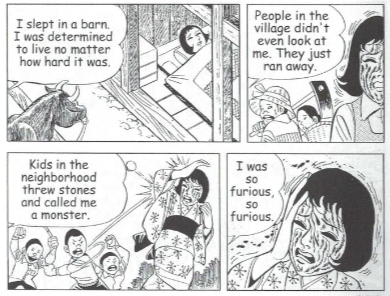
A major element of Gen's story is his role in helping people remember themselves and their humanity after the bombing. He becomes particularly interested in art after working as a caretaker for Seiji Yotsuba, an artist who lost the ability to hold brushes following the bombing and whose family was too disgusted by his injuries to care for him. Gen talks friends out of suicide multiple times, including Natsue, who had been mocked for her facial burns, consistently setting their frustration and anger back towards militarism and the government rather than despairing at their own circumstances. Gen's coming of age and maturation is one of the story’s main plot points; as he ages, he begins speaking out against war and the American occupation. One notable example sees Gen struggle to find a publisher for a late man's atomic bomb-centered novel due to fears over angering the Americans, yet he perseveres and gets the novel published in a prison. The series concludes with Gen traveling to Tokyo, in order to pursue his dream of and love for art, a subject he has long admired for its ability to reach people.
Art Style and Depicting Victims
As a manga series, a critical element of Barefoot Gen is its accompanying artwork, making up the bulk of the storytelling. The art style appears cartoonish, with character’s facial expressions often being intensely exaggerated in moments of joy. Those joyful expressions are also accompanied by characters putting their hands behind their head and their elbows in the air when happy, something that we wouldn’t associate with joy immediately in real life, but it fits in well nonetheless with the cartoonish style of the series.
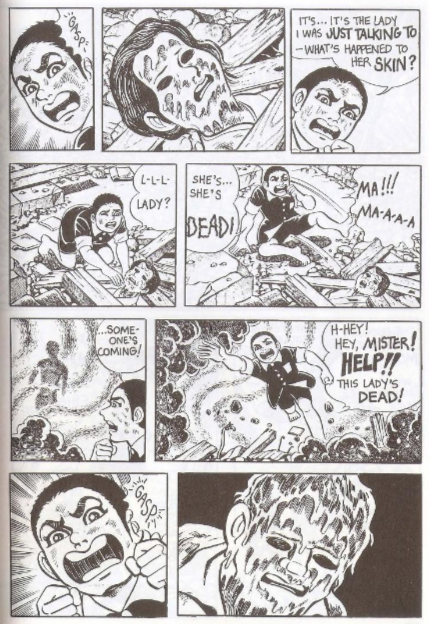
Conversely, the cartoonish style allows for gut-wrenching portrayals of bombing victims; they are depicted as having their skin melted and drooping off their face, as seen below. Though still cartoonish and staying away from gory flesh and blood, these depictions are still deeply unsettling. Seeing a melted human face and body is so far beyond anything we could expect to see in our regular lives that it definitely serves to startle the reader and remind them of the true horrors of the atomic bomb, while not turning the reader off with gore. Gen himself even says, “The people look like monsters!” (Nakazawa 1.254, below), no doubt summarizing Nakazawa’s own thoughts about surviving the atomic bomb. Seeing the one page transition of a woman Gen was talking to during the bombing from a human into a melted corpse, her face having been shaded black with burns, is, to put it bluntly, scary. These burns and black shading are present in many of the bomb’s victims seen in later volumes, such as Seiji and Natsue. This sets them apart from those who were unaffected by the bombing, with their skin almost appearing “charred.” As the physical stigma of having been hit by the bomb hangs over them, we see it represented in their physical depiction.
Human Reaction to the Atomic Bombing
Gen's journey continually sees him in a position where he needs to emotionally support people; talking his friend Natsue down from suicide and encouraging Seiji Yotsuba to continue painting with his mouth even when he couldn't hold a brush are two impactful examples. Why had the atomic bomb left these people, and in a larger sense, the Japanese citizenry, in such a condition? Both Seiji and Natsue's mental states, on the brink of suicide and giving up on life, resulted from people avoiding them due to fear and uncertainty about the nature of the atomic bomb. People in the story commonly refer to it as "the bomb," often excluding mention of the nuclear nature of the weapon. Whether this is a translating quirk or an intentional choice, it fits perfectly with the state of the Japanese populous at time. There was no concern whether or not this bomb had "nuclear" origins, or what was driving it; it was a bomb that had wreaked havoc upon their lives, so nothing else was significant.
Further uncertainty revolved around the radiation sickness experienced by bombing victims; Barefoot Gen depicts acute radiation sickness as largely (and falsely) misunderstood to be contagious. This fear of a contagious, invisible, misunderstood illness is a key source of social stigma faced by many bombing victims, alongside their physical appearance. Nothing is known about this, only calling it "the atomic bomb's poison" (Nakazawa 6.139, below) or "[Seiji's] disease" (Nakazawa 3.159) in each case. The energy source is unimportant, only that this mysterious bomb was different than all the others and resulted in intense illness, though this is seldom attributed to the unique nature of the atomic bomb.
As such, energy afterlives rear their head in a discouraging, sad way: through fear. The fear of any sort of unique and novel scientific advancement due to the scarring (physical and mental) effects of the atomic bomb. In the post-war period that Barefoot Gen chronicles, this makes sense; confusion, fear, and uncertainty swirled around the horrifying explosions. People impacted who were previously healthy were collapsing and dying within days. The characters understand very little about why this is happening, and most horrifyingly, how it’s transmitted, thinking it to be contagious and shunning impacted members of society. This fear drives people to turn on their own family members, leave them to rot in their own blood, and harass total strangers for having a mysterious, deadly disease, in the case of Natsue. While some characters, such as Gen, are driven by a love for humanity and people, the vast majority of Japanese society is depicted as cruel, and avoidant of this mysterious energy source, allowing it to warp their views on humanity, and even shun relatives.
Barefoot Gen is perhaps most horrifying when considering that it is largely autobiographical. Many experiences borne by Gen are likely similar to ones faced by Nakazawa. The cold, societal conditions displayed throughout the story truly depict that, despite all of the atomic bomb's destructive power, it additionally evidenced a hidden, unseen ability to destroy the fabric of a civilization by replacing community and care with fear and loathing. As the first and only place to be subjected to an atomic bombing, post-war Japan experiences this horrid blend of social and medical doom as a result of the bomb, and it threatens to tear apart any sense of community still present in Gen's life. Rather than coming together after disasters as we often imagine a populous to do (such as how our country idealizes and romanticizes America's unity after September 11, 2001), Japanese citizens become more secluded, exclusionary, and reactionary than ever before as a result of the horrors of war inflicted upon them, indicating that nuclear energy's destructive power extends far beyond the physical realm.
Bibliography
Nakazawa, Keiji. Barefoot Gen. Project Gen. 1978. Translated by Project Gen.
Indian soldiers wander Hiroshima, June 1946. https://www.iwm.org.uk/collections/item/object/205193337.