Energy AfterlivesMain MenuIntroductionAboutCoalOilNuclearTextual AfterlivesMusical AfterlivesPlanned and unplanned musical responses to coal, oil, nuclearPhysicalizations and VisualizationsLinks to all our project pagesInterviewsA collection of interviews with writers conducted by Energy Afterlives students.Feedback
Bugscapes: Indoor vs. Outdoor
1media/Bugscales Indoor Outdoor for Scalar_thumb.jpg2024-08-03T11:10:58+00:00Selby Hearthb376ef4984698cd7e5faf6c8e8b2692e30809d8111Bugscapes: Indoor vs. Outdoorplain2024-08-03T11:10:59+00:00Selby Hearthb376ef4984698cd7e5faf6c8e8b2692e30809d81
This page is referenced by:
1media/American_Bird_Grasshopper.jpg2024-08-03T10:04:47+00:00BUGSCAPES18How have human energy systems changed how it feels to be alive .... if you're a bug?image_header2024-08-07T15:17:09+00:00"Energy Afterlives" include obvious environmental impacts, like acid rain, mining waste, and climate change.
But some of these afterlives are less obvious: our sensory experience of the world is also an "Energy Afterlife." Our soundscapes are forever humming with motors, our skin is encased in petro-fibers, our smellscapes are artificial. In our Soundscape project, our students have attempted to visualize how human energy systems impact the sounds we hear every day.
The sensory experiences of the more-than-human world are similarly impacted, but even harder for us humans to notice. In this exercise, our students attempt to visualize how human energy systems have changed how it feels to be alive ... if you're a bug.
Insects senses are familiar to our own (sight, smell, sound), but many types of insect are also hyper-attuned to vibrations in surfaces. How have human energy systems changed the vibrational landscapes of their everyday lives?
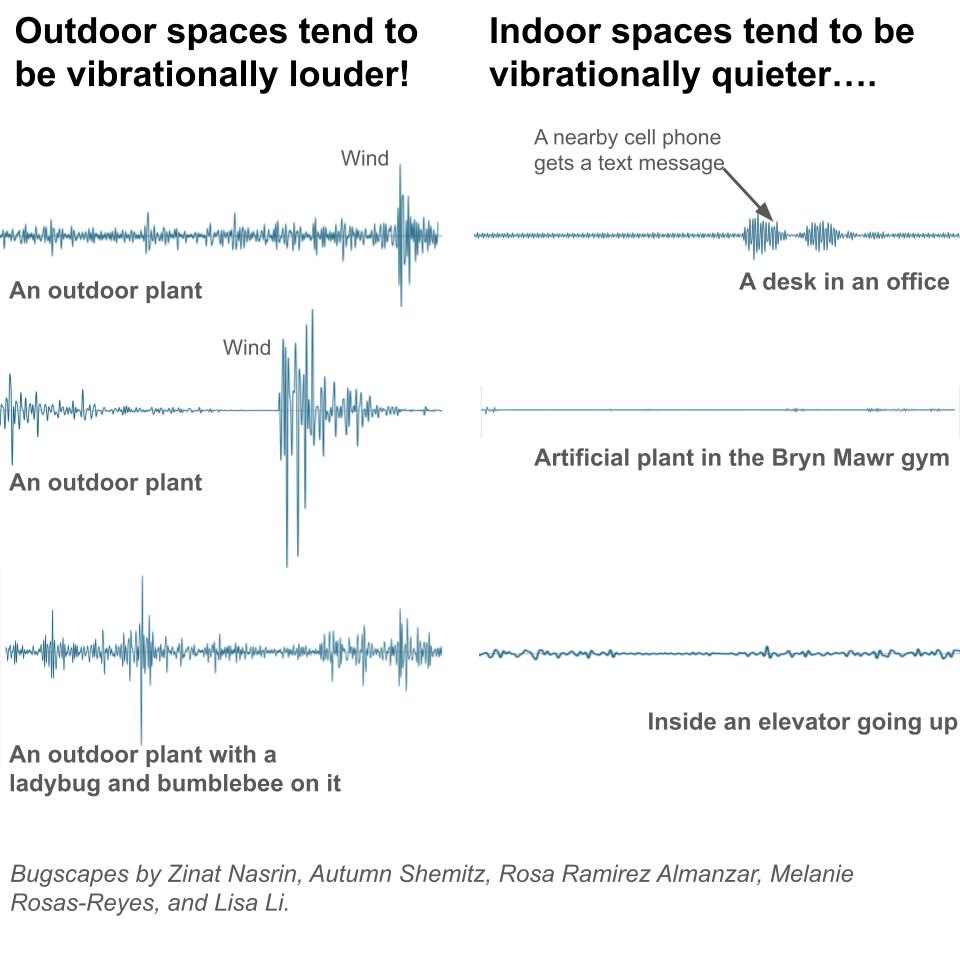
To test this, we rigged up a simple piezoelectric sensor, which measures minute changes in pressure. We attached this to an amplifier, then to a wave recorder app. (In this set-up, we owe a huge debt of gratitude to University of Missouri biologist Rex Cocroft, who developed the sensor set-up we used and was an amazing resource for our students!) The students then clipped the sensor to the surface whose vibrations they wanted to measure, and recorded the resulting vibration-scape.
We had a few observations arise from this process:
The outside world is constantly BUZZING with vibrations! .... but the indoor world is not. Indoor, human-made spaces must feel unusually silent to insects, compared to the wild vibratory natural world.
Our perceptions are limited: there is far more going on in the world than we can notice. Moss crackles with vibrations. The faintest movement of a human hand on a desk echoes through surfaces. Creatures attuned to different scales and senses live in fundamentally different worlds than we do.
Even when we can measure these vibrations, we still struggle to understand. The human ear is capable of identifying different sounds from within a mix of soundwaves arriving at our ear: this component is the air conditioner, this component is someone speaking, etc. But we can't do the same with vibrations: the waves record are just a single wave for us. We can measure what an insect might feel — but we can't understand what it means like they can.