Issue 12, Page 2
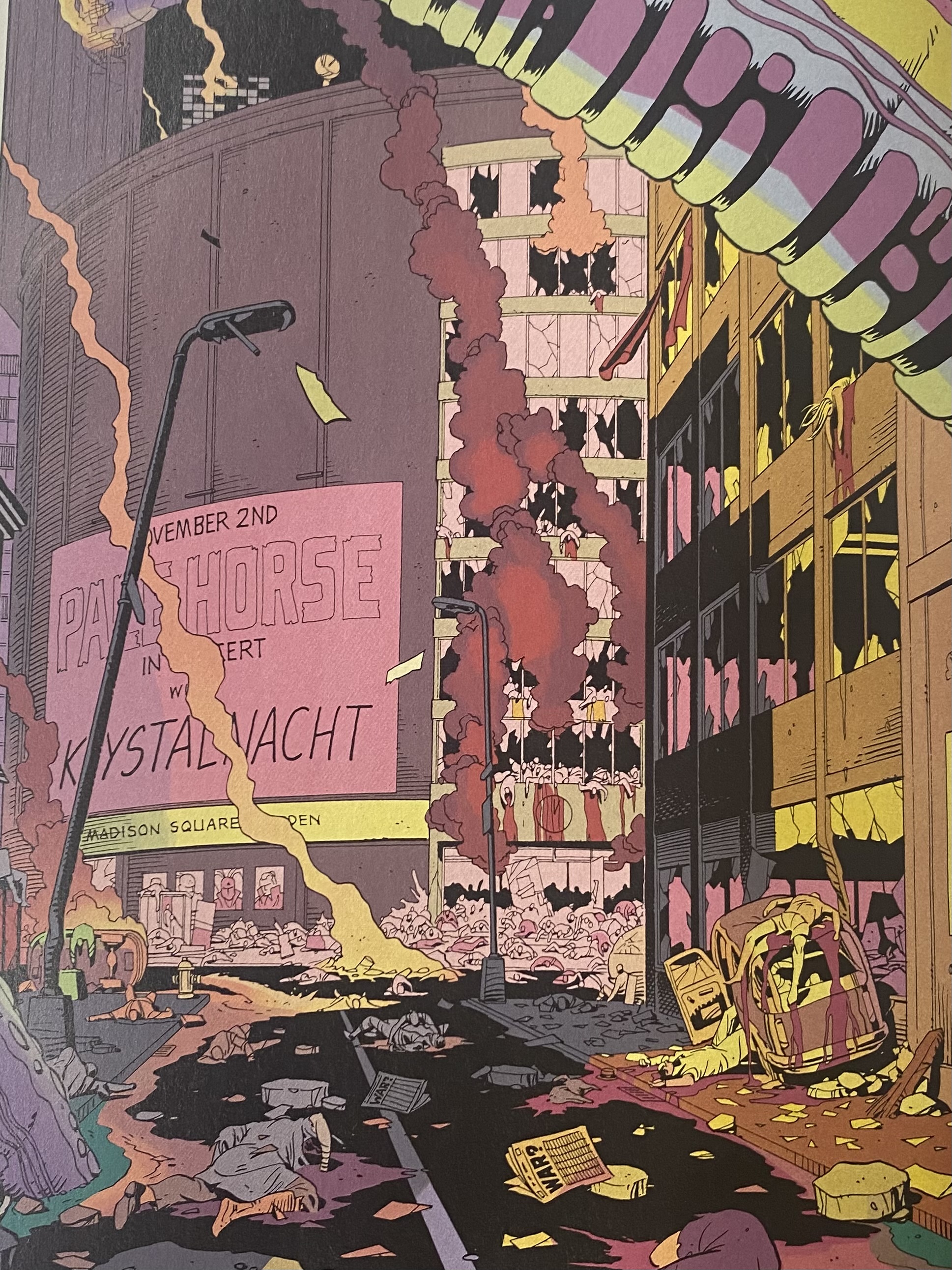
1 media/IMG_0685_thumb.jpg 2023-12-03T06:02:47+00:00 Clio Morbello 2c691807edd1cc759e796a971015d3bc6518a760 1 2 The destruction caused by Ozymandias' alien attack, with sign promoting "Pale Horse" and "Krystalnacht" concert in the background. plain 2023-12-03T06:29:36+00:00 Watchmen issue 12 page 2 December 3rd 2023 Clio Morbello 2c691807edd1cc759e796a971015d3bc6518a760This page is referenced by:
-
1
media/IMG_0685.jpg
media/72327217502__CC268D30-A39B-4B3B-8FA8-8CD018AA19F0.jpg
2023-12-03T04:39:24+00:00
Watchmen by Alan Moore and Dave Gibbons (1968)
43
A Cold War comic book series imagining an alternate nuclear future... with superheroes.
image_header
2023-12-24T00:56:46+00:00
What would the world have been like if the development of American nuclear technology had never been impeded?
If we hadn’t lost the war in Vietnam, if there hadn’t been a widespread anti-nuclear movement, and if we had ensured that our side had the true end-all weapon, the 1980s and the Cold War would have looked quite different. The limited comic book series Watchmen, written by Alan Moore and illustrated by Dave Gibbons, explores this alternate reality through the narrative of costumed heroes, ordinary people, and a god.
The canon of Watchmen first diverges from reality in 1938 when a costumed man, nicknamed “Hooded Justice” by the press, appeared on the streets of Queens to fight crime. Others soon joined him in forming “The Minutemen,” a group that modeled their looks and behavior off of comic-book superheroes. They remained active and largely unregulated through the second world war, but otherwise, events progressed as they did in real life. In 1960, a freak accident at a nuclear experimentation lab turned nuclear physicist Jon Osterman into something more than human. In his origin story sequence, Jon steps into a testing vault that removes his “intrinsic field” (a fictional creation of the series) and disassembles his body at a nuclear level. His core consciousness survives and recreates a body that can shoot lasers out of its hands, conjure glass castles out of sand, see its own future, create lithium from nothing, and teleport. The electromagnetic pattern that once belonged to Jon is renamed “Dr. Manhattan” by the American media. His transformation irrevocably shapes the future of Watchmen’s world. The war is won in Vietnam, President Nixon is elected five times in a row, and tensions between America and Russia are heightened, although all-out violence is indefinitely prolonged. After a short-lived, second iteration of The Minutemen was assembled by the main characters of this story, the Keene Act of 1977 outlawed costumed adventuring for all except those working for the government, Dr. Manhattan and The Comedian. Rorschach, another vigilante, is the only other costumed individual still active at the beginning of the series.
The core conflict of Watchmen revolves around Ozymandias, another former masked adventurer, who plots to stage a massive alien attack on New York City. While investigating the mysterious death of The Comedian, costumed heroes Rorschach, Nite Owl, and Silk Spectre uncover his plan and attempt to stop it.
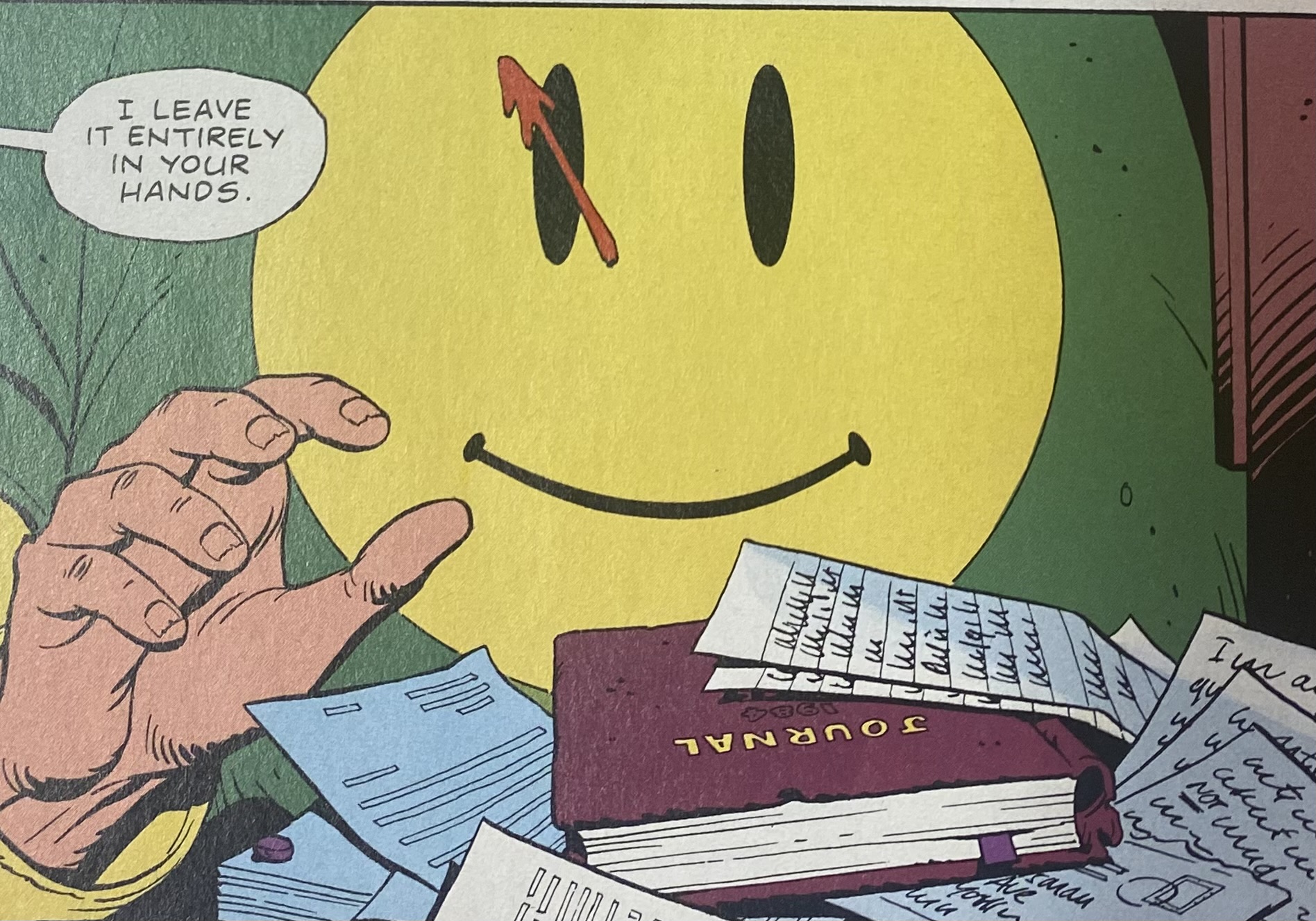
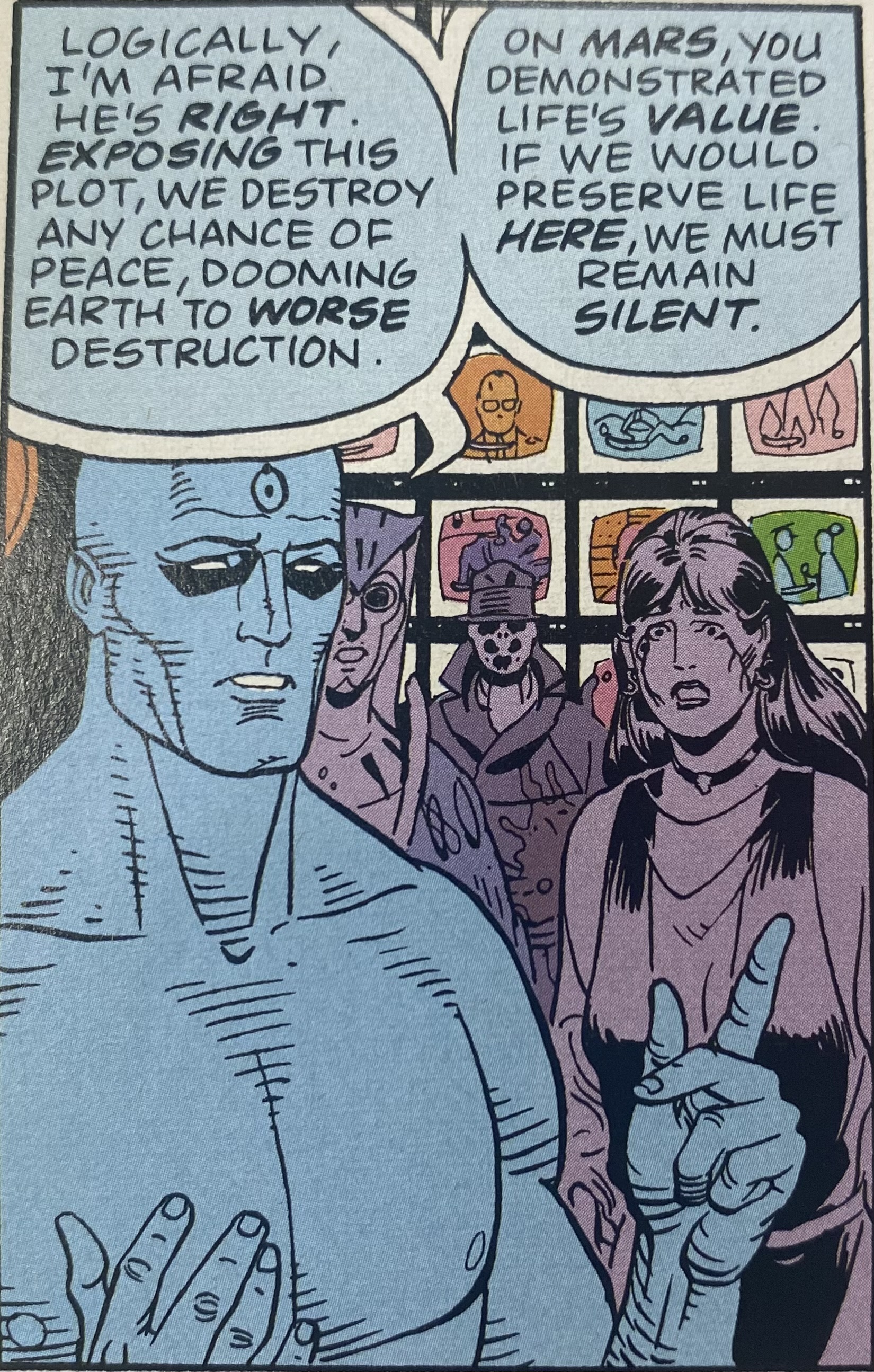
The key players in Watchmen are Dr. Manhattan (Jon Osterman) and the second generation of costumed adventurers, The Comedian (Eddie Blake), Rorschach (Walter Kovacs), Ozymandias (Adrian Veidt), and the second iterations of Silk Spectre (Laurie Juspeczyk) and Nite Owl (Dan Drieberg). Rorschach leads the investigation into The Comedian’s death, following what he believes to be the trail of a concentrated assassination effort against costumed adventurers. Dr. Manhattan is provoked into leaving Earth, coming back briefly to bring Laurie with him to Mars. As Russia begins “securing its borders,” Dan and Rorschach discover Ozymandias’ plot but are unable to prevent its execution. Ozymandias has engineered a massive tentacled creature, using technology made possible by Dr. Manhattan and the labor of various artists and sci-fi authors, that he teleports to the heart of New York City. It dies on impact and releases a psychic shockwave that kills three million people. In uniting the world against a common enemy, Ozymandias hopes to prevent what he views as an otherwise inevitable nuclear war. Laurie convinces Dr. Manhattan to return to Earth, and they appear at Ozymandias’ lair. Dr. Manhattan then protects Ozymandias, killing Rorschach before he can return to New York City to reveal the truth, as doing so would undo the tentative world peace. After the fact, Ozymandias asks Dr. Manhattan whether he was right in calculating the deaths as worth it, whether it had all worked out in the end. Dr. Manhattan replies that nothing ever ends. Rorschach’s journal, in which he details the truth of Ozymandias’ plot, is found on the desk of a newspaper office back in New York.
Cold War Anxieties
Moore and Gibbons created Watchmen at the height of anti-nuclear tensions during the 1980s, and published the first issue mere months before the Chornobyl nuclear reactor accident in 1986. The core question of Watchmen, as stated by Moore in an interview, is how one can bear to live with the constant fear of nuclear annihilation and the knowledge that at any moment the bombs might have already been launched. The series is a criticism of the powers that be, and a celebration of resistance.
“God is real, and he’s American,” writes a physicist in issue four. Dr. Manhattan is the nuclear superhero, and the world of Watchmen is one in which the American perception of nuclear power never had a real reason to turn negative. Nevertheless, Cold War tensions had been building before the creation of Dr. Manhattan. Ozymandias, who is an incredible genius but not superpowered in the traditional sense, describes these anxieties as being at the root of his feigned alien attack. In a calculation fueled by his massive ego, Ozymandias had decided that nuclear war was nearly inevitable.
Although cultural fears over mutually assured destruction are present in the series, they never become organized into a significant anti-nuclear movement. Furthermore, resistance against the Vietnam war never contributes to the development of American protest movements. Dr. Manhattan’s presence has precluded Cold War escalation by Russia and has changed the American mythology of nuclear power. His absence was so quickly followed by a rapidly growing threat of war that the world had little time to readjust to the newly intense existential threat of the bomb in any way but with paralyzing fear.
Inevitability of the Bomb
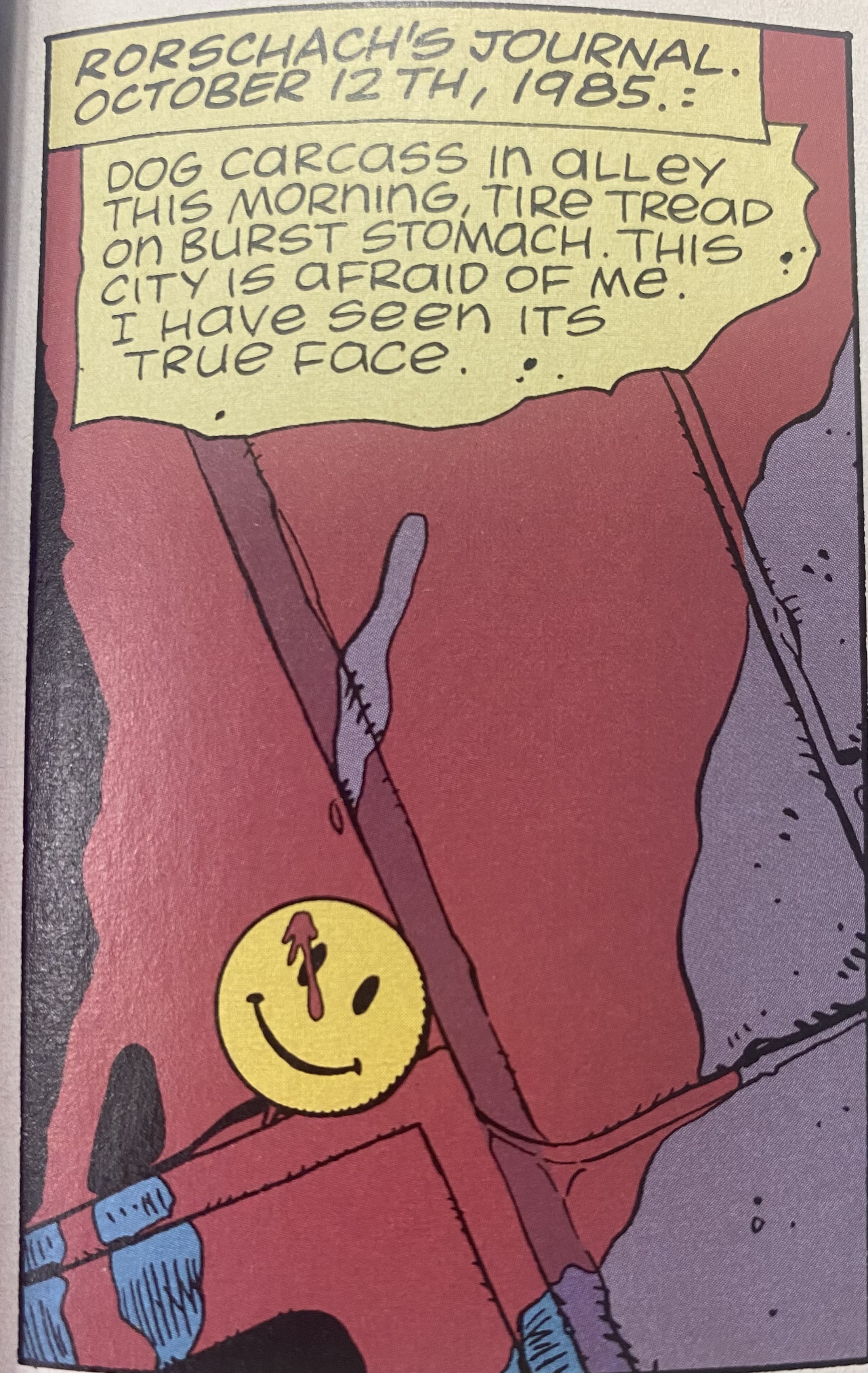
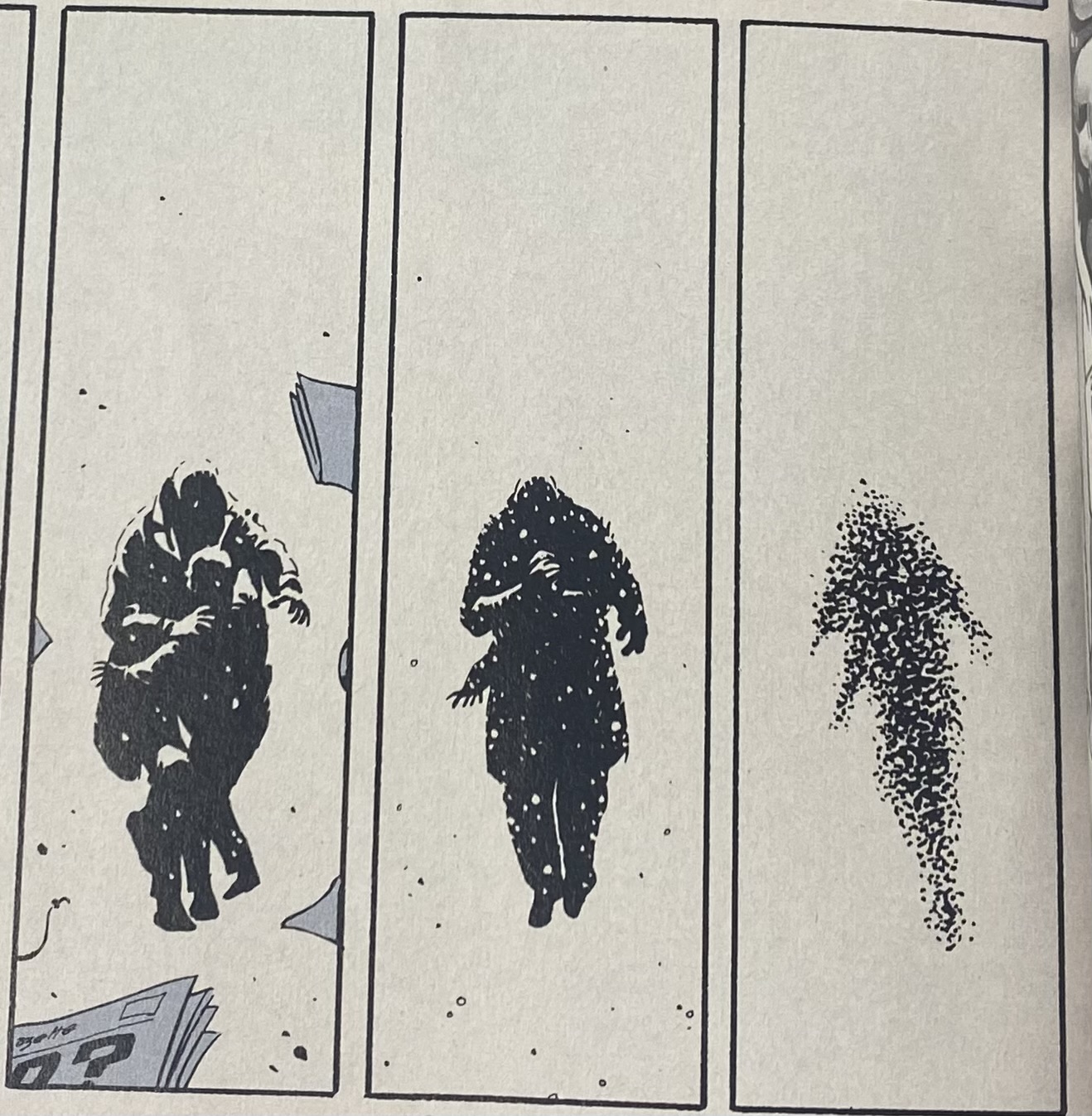
The theme of inevitability and a warping of linear time to fit the scope of nuclear power is central to the series. Many images repeat themselves: the blood splat on the Comedian’s pin at the beginning of the series is mirrored in the sand when Dr. Manhattan absconds to Mars, in the silhouette of two embracing side characters as they are killed by Ozymandias’ alien, and again as the final image of the series as a ketchup stain on a boy’s shirt. The silhouette of two embracing lovers graffitied on the wall, nicknamed “The Hiroshima Lovers” by Rorschach, is echoed in the shadow of Dan and Laurie’s embrace in the last issue. Ephemera of humanity’s prior attempts to reckon with tragedy appear in the background of stunning full-page spreads of the alien’s shockwave, including the promotion of two bands called “Pale Horse” (a reference to the fourth seal of the biblical apocalypse) and “Krystalnacht.” (12:2)
Dr. Manhattan embodies this theme most explicitly. As a side effect of his powers, he does not experience time in a linear way, and instead views the past, present, and future in overlapping shades of existence. Forever caught in this perspective, he is alienated from others and distanced from contemporary reality, to the constant frustration of his partner Laurie. Nuclear power defies human, temporal comprehension, with plutonium harkening back to an unfathomably distant past and radiation afterlives stretching impossibly far into the future. Dr. Manhattan also understands that history repeats itself, a fact supported by the various repeated visual motifs. Ozymandias’ greatest mistake is believing that there could even hypothetically exist a crisis large enough that it could undo the damage of nuclear armament. In truth, nuclear power has always been here to stay. As soon as the bomb was developed, it became part of the past, present, and future of the planet.
Layers of Evil
The original costumed heroes operate using the old rules of the game. Upon his expulsion from The Minutemen for the sexual assault of the original Silk Spectre, The Comedian was adopted by the U.S. military as a symbol of patriotic, American justice, fighting in both WWII and Vietnam. He was prone to exceptional bouts of violence and perversion and gleefully laughed through carnage, but at his core he remained verifiably human. The Comedian discovered Ozymandias’ alien on accident while it was still being constructed. A week before Ozymandias murdered him, he broke into the home of Edgar Jacobi, a former costumed villain (Moloch), and drunkenly rambled that he no longer understood the rules, that there was something incomprehensible coming at which he could no longer laugh. The alien fundamentally defied the framework of conflict in which he operated in the same way that the atom bomb fundamentally changed the way human battles were to be fought from then on. With the invention of the bomb, the scale of evil that humans could enact on one another was bloated unfathomably out of proportion.
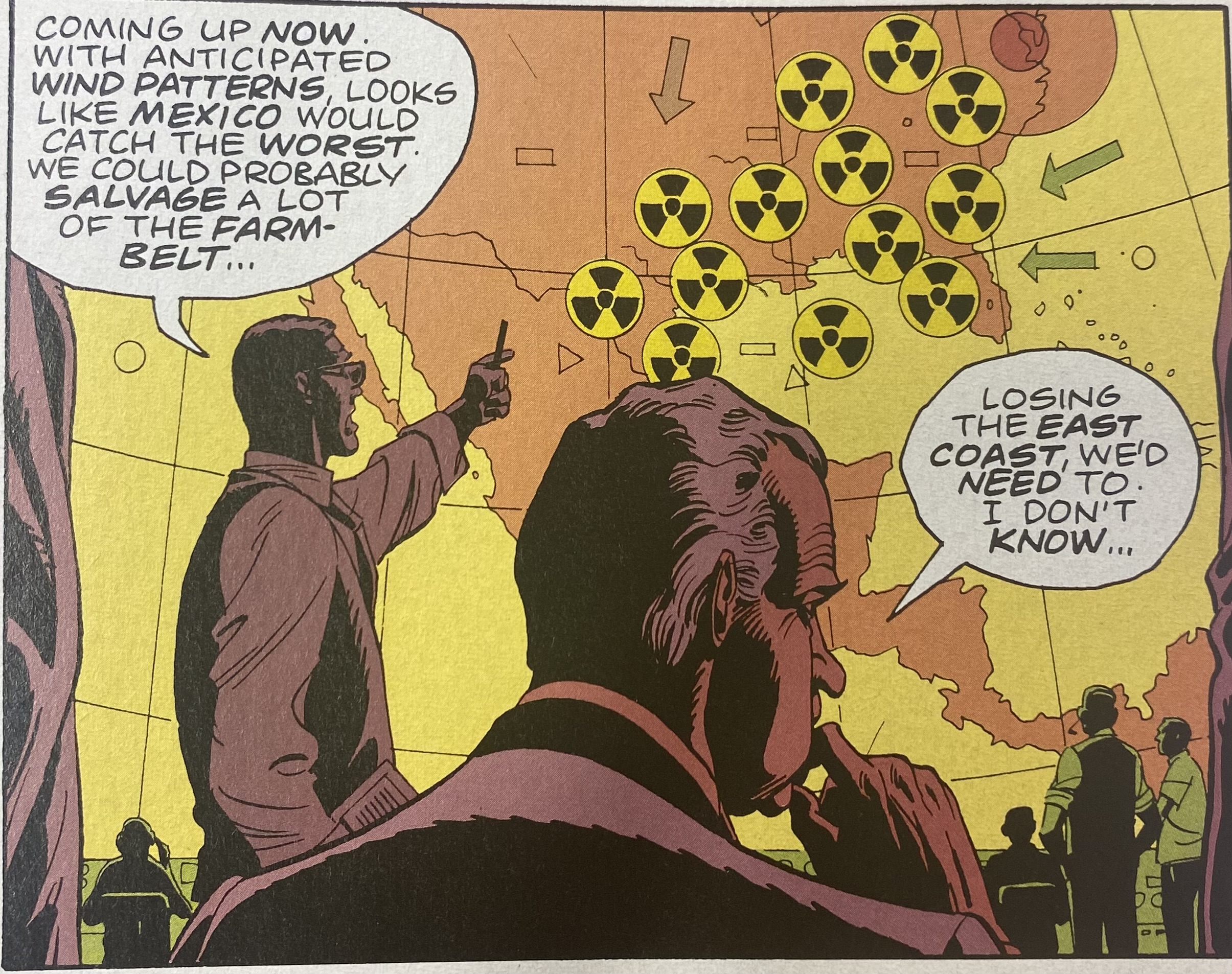
Ozymandias and Dr. Manhattan are the only two truly “powered” beings in the series, and they both struggle with feeling detached from the rest of humanity. Ozymandias’ incredible intellect brings with it a superhuman ego and an inability to operate on the level of other people. His creation of a superweapon comes from a distrust in human ability to tackle the superhuman threat of nuclear war. Both characters justify the use of the alien by weighing potential deaths against each other– three million dead in an alien attack is a lot of people, but a lot less than would be potentially killed in a nuclear war. Dr. Manhattan recounts a time in which he teleported a group of protestors to their homes. Two people suffered heart attacks, but he justifies that more would have been hurt in the protest itself. The U.S. Government, under Nixon, similarly justifies deaths when looking at the projected paths of Russian warheads after Dr. Manhattan’s departure, planning to “lose the East Coast” if need be. Ozymandias has spent a great amount of time perfecting his image– he remains the only costumed hero in good favor with the public– and legitimizes his attack to himself by saying he will sit with the deaths and mourn each one of them, an empty promise that means nothing material for his victims. If Dr. Manhattan is a God, Ozymandias is the United States government. They represent both the religious reverence commanded by nuclear power as well as the egotistical, fallible, detached yet unpredictable forces behind its usage.
Bibliography
Dr. Manhattan has no real motivation or morals, and his current state bears little resemblance to his human roots. His alignment to the U.S. government is contingent on nothing but that he has seen himself being loyal in his future, although to some degree he is invested in his partner Laurie and the humanity she represents. Otherwise, he leaves the planet on a whim, brings Laurie there because they have a “scheduled” conversation, and returns because he has predicted that he will eventually. The United States Government turns him into a commercial symbol, and Ozymandias furthers this dehumanization by planting cancer in the people who were closest to Jon, including his ex-girlfriend, his ex-nemesis Moloch, and his close friend from back at the nuclear testing lab.
In Watchmen, it seems as though humanity has become a construct dependent on certain performances. Dr. Manhattan does not adhere to normal human standards, walking around naked and teleporting disorientingly, but neither does Ozymandias, who calculates like a machine with little regard for the value of individual life. Hollis Mason, the original Nite Owl, writes in his memoir that the arrival of Dr. Manhattan left humanity with the feeling that “we’ve been replaced,” that everything had been different from then on. If we take Dr. Manhattan to represent nuclear arms more generally, a core message of the novel is that the development of nuclear power forced everyone to question the bounds of humanity itself. What does it mean to be human in a world of post-human forces?
Humanity Perseveres
The hope of the series comes from ordinary people, who express their humanity in various ways running counter to the goals of the powerful. Most self-proclaimed heroes become disillusioned or are prevented from fighting crime due to the Keene Act, which followed massive anti-hero protests. At the end of the series, President Nixon is finally challenged for the presidency by Robert Redford. Dr. Manhattan’s jealousy and need for human contact limit his godly potential while his powers simultaneously distance him from the people he craves connection with. The victory of Ozymandias is dampened by his own short-sightedness.
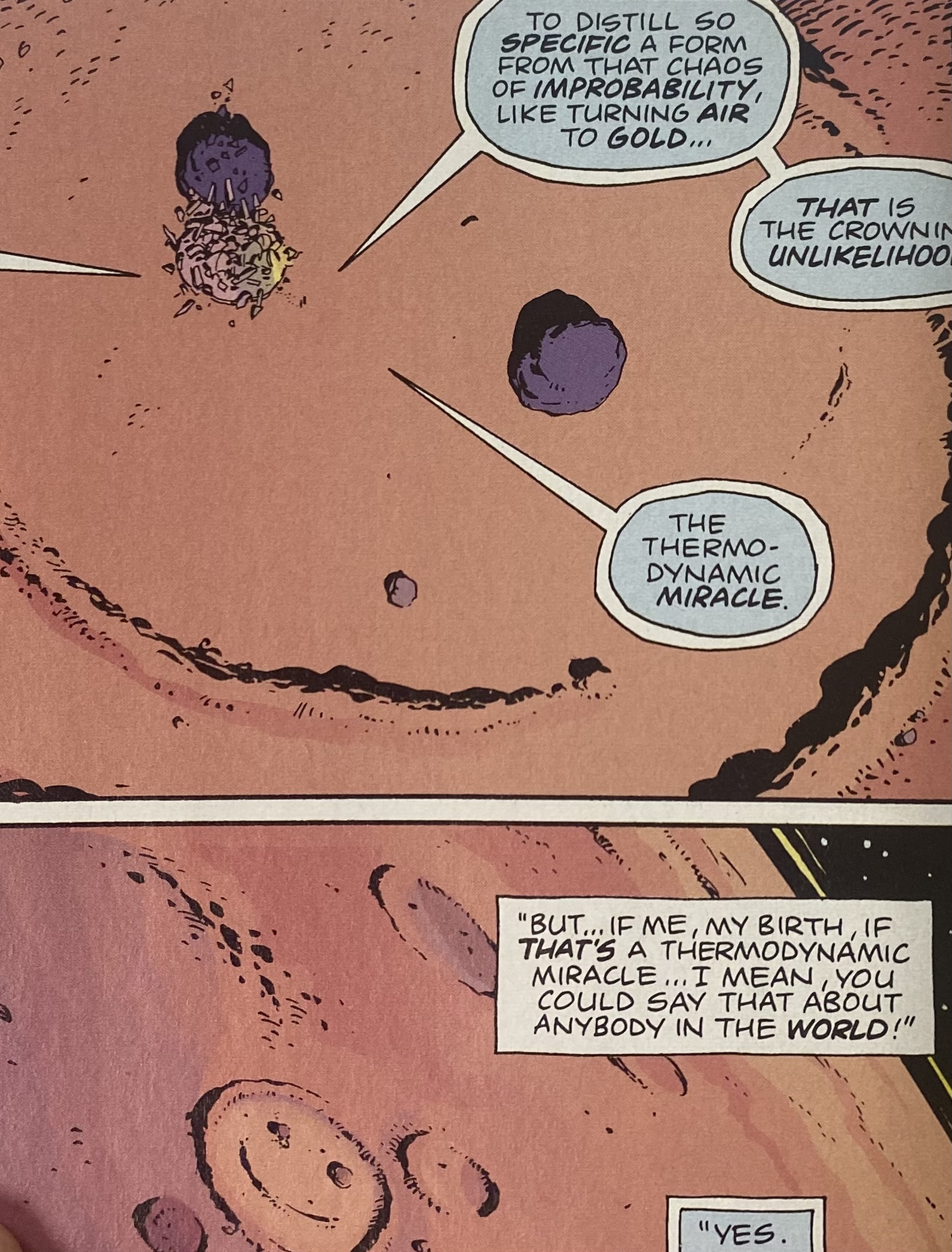
At the end of the last issue, right before Ozymandias’ alien attack is carried out on New York City, a whole slew of background characters from earlier issues convene to break up a fight in the street, and they hug each other as the psychic shockwave kills them. At one point, Dan and Laurie risk their lives to spring Rorschach from jail because they know they need him to finish his investigation, but also because he’s their friend. Rorschach does not compromise on his morals, rejecting Ozymandias’ request to keep silent by sending his journal back to New York. Dr. Manhattan does not initially believe that humanity holds any interest for him, but Laurie actually changes his mind. By the end of the series, he has come to believe that the spontaneity and inherent improbability in every human life is a “thermodynamic miracle” of the highest order (7:27).
Acts of compassion and kindness, cooperation, and love, although they cannot prevent the inevitable alien attack, are the true value of humanity and the core of its beauty in Watchmen. Laurie, the second iteration of her mother’s costumed persona, represents a continuation of the old ways and acts as a check on Dr. Manhattan by grounding him in reality. Humans themselves, it seems, are a powerful catch on the expansion of ourselves and our technology beyond the bounds of humanity, e.g. the use of the bomb. The chaotic unpredictability of humanity and its course could not be predicted by either Ozymandias or Dr. Manhattan. From this chaos come moments of beauty that astound even the god of Watchmen.
A common sentiment decorates the streets of the fictional New York: Who watches the Watchmen? Who holds those in power– the government, the man made gods and technological forces that we cannot reckon with– accountable? The answer is us, the ordinary people who love, cooperate, learn, and move through the world together.
Moore, Alan, and Dave Gibbons. Watchmen. DC Comics, 1986.