Topsy-Turvy Doll Google Search 2
1 media/Screen Shot 2022-08-07 at 8.15.42 PM_thumb.png 2022-08-08T00:16:10+00:00 José Vergara 9d7e6dfed9d57006cb53f94a7107fbf1500f2da2 1 2 Screenshot of Topsy-Turvy Doll Google Search plain 2022-08-08T00:17:35+00:00 José Vergara 9d7e6dfed9d57006cb53f94a7107fbf1500f2da2This page is referenced by:
-
1
2022-08-01T03:16:31+00:00
This Atom Bomb in Me
62
An Exploration of America's Love Affair with Nuclear Energy
image_header
2022-08-08T00:17:13+00:00
This Atom Bomb in Me
This Atom Bomb in Me by Lindsey A. Freeman is a haunting memoir about what it felt like to grow up in Oak Ridge, Tennessee, where the Manhattan Project took place. The Manhattan Project was a war effort by the United States government to develop an atomic bomb during World War Two. Though Freeman wasn’t alive during the war, the effects on Oak Ridge stayed, touching everyone who lived there for generations. Freeman writes about what it was like growing up being raised by her mother and grandparents, who lived in Oak Ridge and worked on the Manhattan Project.
Freeman is now an author in her forties and professor of sociology at Simon Fraser University. Her memoir uses short vignettes about her life starting as a young girl and growing older, realizing the history and impact of where she comes from. Oak Ridge has the largest supply of fissionable uranium and was responsible for the atomic bomb that was used in Hiroshima. Freeman’s grandfather was also one of the truck drivers for this project and continued working for Oak Ridge National Laboratory until after the Cold War. Lindsey Freeman focuses on her childhood, looking back with love but also a critical eye, finding the ways in which her community was taken advantage of and also instrumental in the killing of over 135,000 people (AtomicArchive).
Power in Nuclear Energy
This Atom Bomb in Me explores America’s love affair with nuclear energy, both the fascination and the fear. Nuclear energy gives humans a chance at world domination while having effects we would not ever be able to fully comprehend. Freeman writes about living around radiation as a commonplace thing, but also that it was connected to the things she enjoyed during her childhood: “We played soccer by a sweet little creek that was so gentle we never thought to ask if the water was laced with strontium-90 or toxic mercury” (Freeman 69). Some of her best memories are in a place that is literally poisoning her.Freeman writes about her childhood memories in Oak Ridge, highlighting the fear that accompanies nuclear power. She writes about how nuclear energy made its way into every aspect of her life. In elementary school, kids traded Garbage Pail Kids, collectable cards with cartoons of mangled kids with catchy names on them. The one that she was most afraid of but also loved the most was Adam Bomb, a child in a suit pushing a red button that makes his head explode (Freeman 105). Bombs were so intertwined with the culture in Oak Ridge that kids traded cards with dying children on them as their Pokemon cards. The most disturbing part about Adam Bomb is that he seems to have “a lazy smile on his face” (Freeman 105). This represents America's attitude toward atomic bombs. Adam Bomb wears a suit as if he is an executive in corporate America, looking to profit off of the nuclear industry. He smiles as he blows himself up because he is not thinking about the effects of his actions, he is only thinking about the power it gives him and the money he can make.
Scientific Paradise
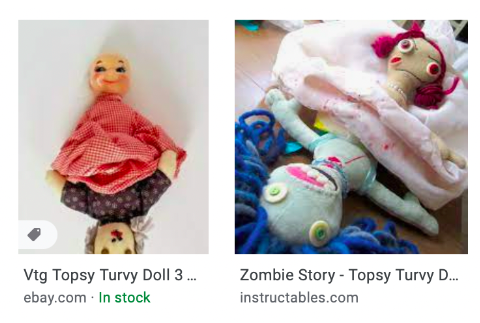
In Freeman's childhood, Oak Ridge was a place of wonder, and in her adulthood a place of destruction. The best way Freeman describes our relationship with nuclear power is as a Topsy-Turvy doll, in which two characters, usually the hero and the villain, are sewn together at the base. The character’s outfits cover each other, but every now and then you can still see the other poking out of the bottom of the first character’s outfit (Freeman 30). These two dolls are inseparable, like two sides of the same coin, and they represent Freeman’s experience with nuclear energy. One character, the hero, is her town; it puts on a good front. Even in the town logo this is evident, an atom with an acorn nucleus in the center. The atom connotes positive scientific discovery and forward movement, while the acorn represents nature and innocence. She describes Oak Ridge almost as a scientific paradise, in which she feels surrounded by geniuses and new technology. The other side of that doll, the villain, is the bomb the government creates from that town. This is symbolic of America’s relationship with nuclear power as a whole, both the mass destruction it creates and the complete awe, amazement, and pride that people take in scientific inventions.
Reflecting on the Nuclear Past
Freeman writes about her grandfather, an atomic courier. It is hard to know whether or not Freeman’s grandfather knew what he was doing, driving around mysterious substances for the lab. Her family saw what was happening on the news, with the creation of the atomic bomb, but they had no idea what materials he was transporting, since that was “above his security clearance” (90). As a worker he is a pawn for the corporation and has no real value to them other than his ability to drive around the materials they need to build a bomb. This creates yet another head on that same doll, that people live in different realities in the same place due to their economic status. In many cases, money buys knowledge and power, creating different realities for people living in the same place. The head of the Oak Ridge National Laboratory is living in a very different Oak Ridge than Freeman and her grandfather. He knew the danger and magnitude of the projects he was working on, but also in some ways he will never be able to fully comprehend the consequences of the nuclear energy he has created.This Atom Bomb in Me describes Freeman’s experience growing up around nuclear energy. She writes with a sense of nostalgia, but also questions some of the things she was taught growing up. The memoir is a close up of Freeman trying to untangle her relationship with nuclear energy. She looks for the visible and invisible ways it colored her childhood and stained her family history. By looking back and reflecting on our relationship with nuclear energy, both perosnally and as a society, we might be able to move forward, diffusing the atom bomb in all of us.
Works Cited
Freeman, Lindsey A. This Atom Bomb in Me. Redwood Press, 2019.
“The Atomic Bombings of Hiroshima and Nagasaki.” Total Casualties | The Atomic Bombings of Hiroshima and Nagasaki | Historical Documents, https://www.atomicarchive.com/resources/documents/med/med_chp10.html.