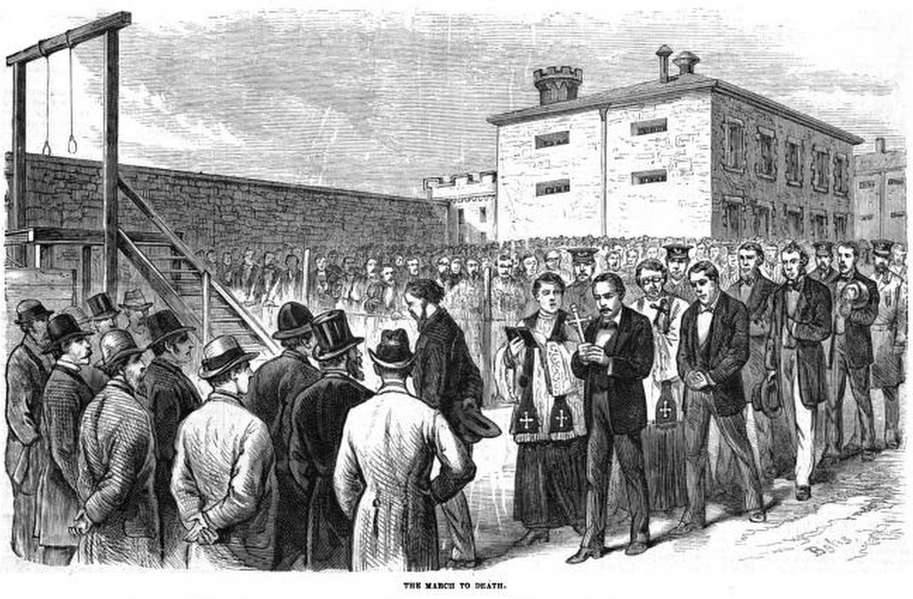
The March to Death
1 2022-07-31T18:15:31+00:00 Grace Trembath a2b0394dc9e981ebcb80fc0a1b48a9485107bd8d 1 1 The last march of eleven Molly Maguires before execution at Pottsville, Pennsylvania on June 21, 1877. plain 2022-07-31T18:15:31+00:00 Via commons.wikimedia Grace Trembath a2b0394dc9e981ebcb80fc0a1b48a9485107bd8dThis page is referenced by:
-
1
2022-07-31T17:53:57+00:00
The Molly Maguires: Exploitation, Identity, and Violence
37
image_header
2022-08-08T00:53:24+00:00
Director: Martin Ritt, Born March 2, 1914 in New York City, New York. Died December 8, 1990 in Santa Monica, California of heart disease.
Set in 1876 Schuylkill County, Pennsylvania, a coal mining town, The Molly Maguires follows a group of Irish immigrants in their struggle against the exploitative company that owns both the mines they work in and the town they live in. The conditions in the mine are awful: it is cold, dirty, home to explosive gas, and it is awfully dark, with the only light available being small, open-flame headlamps. The company that owns the mines gouges the workers' pay, charging them for the equipment they use to extract the coal, turning a paycheck of 9.26$ into a paycheck of .26$. To make matters worse, the only stores in town are the bar and the company store, so even the pennies they are paid are reclaimed by the company. The miners grow so sick of this exploitation that they form a secret society/gang, led by a man named Jack Keyhoe, called the Molly Maguires after a ruffian group in Ireland. They retaliate by blowing up parts of the mine or train track, or by killing members of the company police. James McParlan (Sean Connery) is a detective sent undercover by the company police to weed out the gang.
One of the first shots of the film demonstrates exactly the plight of the miners. As the men are returning from their shift in the mines, we see a group of them walking away from the coal preparation plant (CPP), the large building responsible for sorting out pieces of other rock, such as slate. The camera continues to pan out, eventually leaving only one man in the shot next to the giant CPP; he is dwarfed by it. The miner is insignificant in the eyes of the company, who see him as a tiny cog in their giant money machines.
At almost exactly 33 minutes into the film, the camera cuts to a long line of both children and men, covered in soot, waiting to be paid. The camera pans along to the front of this line, where we see the foreman accounting the wages for each man, telling him what he earned followed immediately by how much is being deducted. McParlan, who at this point in the film is going by James Mckenna as he is undercover, earned 9.26$, but due to needing to use tools and equipment to mine coal, his pay is deducted to .26¢. This is made extra awful considering the fact that most mining towns of this era were owned almost exclusively by the company that owns the mine, meaning that they own your house and the only stores are company stores, so even that 26¢ will be reclaimed eventually. The mines do not care about the miners, as long as their bottom line is met.
This repeated exploitation and disregard for their labor drives the miners further away from aspects of their identity they once held very close. In The Molly Maguires, this identity is religion. Many of the miners are either shown to be, or were once, Catholic, and the Reverend is a figurehead in town who has been living there for six years. After one of the Mollies is arrested by the company police and charged with first degree murder, which is punishable by death, Jack has a conversation with the Reverend. They speak of how Jack was once an active part of the church, but was disillusioned by it after repeated exploitation from the mining company. The Reverend is very vocal about his feelings for the Mollies methods, even after an innocent husband and wife are murdered by the company police in their beds, saying, “They’ve both found their peace, I wish I could say the same for the rest of you” (Ritt, 1:33:40). This disapproval is also held by Miss Mary Raines, whose father was a miner, saying, “There is no future for what you’ve joined except Hell” (1:01:10). However, when a few of the Mollies are arrested for a murder they did in fact commit, she lies for them, she sins for them. She chooses the miners over the company and her own religious beliefs, and apparently others did the same seeing as twelve other people came forward to give the Mollies alibis, twelve other people willing to forsake their religious beliefs to spite the company. A group that holds their religion so incredibly close to their hearts is driven to forsake it in place of this new community they found that is built upon worn down hopelessness.This new community that the miners create is built upon violence, yet another reason so many of them forsake or lose their religious identity, but there really is no other way for the miners to push back against the exploitation they experience. The Mollies talk of how they had “stayed out for six months,” longer than any strike had lasted before, but still they lost: “They cracked the whip, we crawled. We tried peaceful and ended begging” (47:46). Their peaceful attempts to achieve better conditions for themselves is met with violence, so they retaliate with more violence, yet another way the company strips them of their values. The tension and anger brewing amongst the miners towards the company comes to a head after the death of old Mr. Raines, who worked in the mines for 42 years. During his wake/last rites Jack grows more and more angry at both Mr. Raines and the company for what they did to him, triggered by the fact that even though Mr. Raines essentially dedicated his entire life to the mine and he still didn't have a suit to be buried in. However, what Jack was more unsettled by was how broken down Mr. Raines was by the end of his life, how he never made “a sound of his own,” that he spent “42 years in the pits, not even an echo left in the air” (1:47:00).
Ultimately, this film is a story about the exploitation of coal miners and the effects it has on them: hopelessness, loss of identity, as well as the violence that follows when they have had enough of it. But the Mollies know that they can’t truly win against the company, even if they use violence, Jack even says so himself when James asks him, “Do you think you really could have won?” and he essentially says no (2:00:00). To Jack, “there are them on top, and them below” and all them below can do is push up as much as they can. As he says to James whilst they burn down the company store, “We’ll show ‘em spirit Jimmy, we’re not dead yet!” (2:00:00, 1:50:00). The miners know that they can’t truly win, and there is no where else for them to go, so all that is left for them to do is to build what community they can, make noise, and push back.
Works Cited
The Molly Maguires. Directed by Martin Ritt, performances by Sean Connery, Richard Harris, and Samantha Eggar. Tamn Productions, 1970Harting, J.J. “Martin Ritt Biography.” IMDB, https://www.imdb.com/name/nm0728688/bio?ref_=nm_ov_bio_sm .
“The Molly Maguires.” IMDB, https://www.imdb.com/title/tt0066090/.