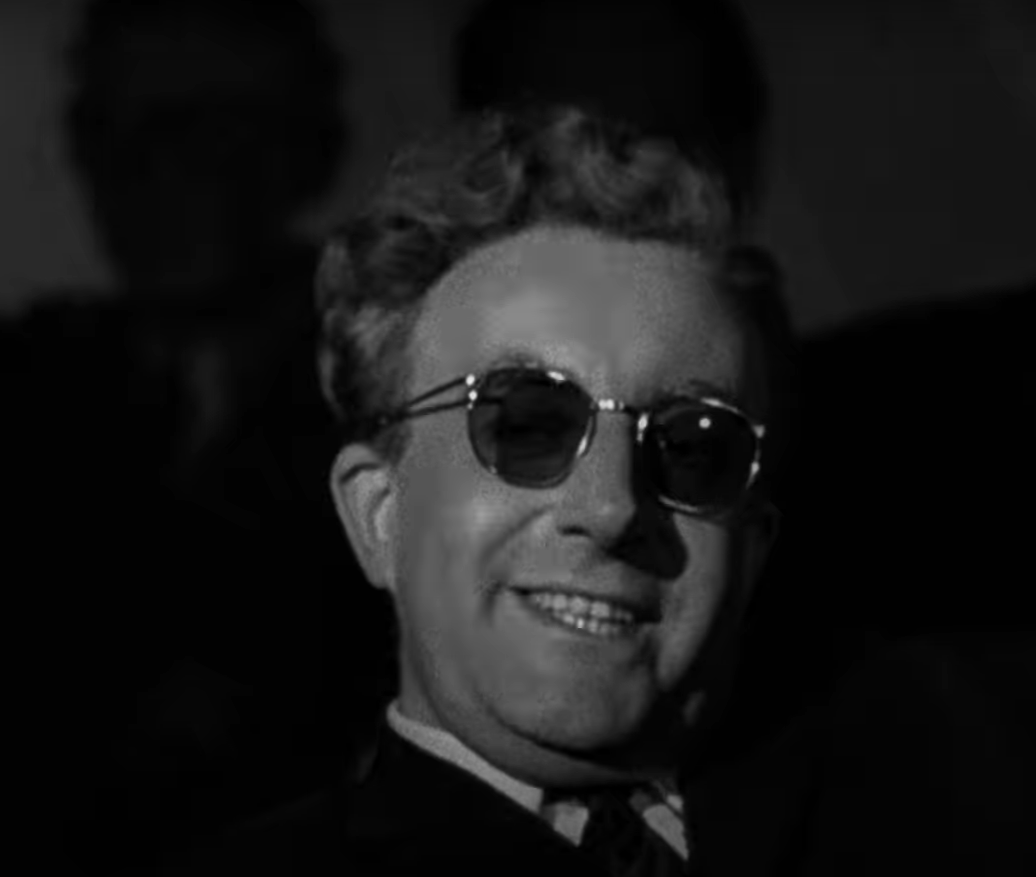
Dr. Strangelove Poster
1 2022-07-31T20:34:10+00:00 Anna Gray Ashton 2aa6305b3e31ca65bdda89ce9e9ef6ae14d07758 1 1 plain 2022-07-31T20:34:10+00:00 Tomi Ungerer Anna Gray Ashton 2aa6305b3e31ca65bdda89ce9e9ef6ae14d07758This page is referenced by:
-
1
media/Dr. Strangelove War Room.png
media/Dr. Strangelove Plane.png
2022-07-29T02:56:36+00:00
Dr. Strangelove or: How I Learned to Stop Worrying and Love the Bomb
56
Stanley Kubrick's 1964 highly-acclaimed dark comedy which shows what might happen if nuclear bomb codes were put in the wrong hands.
image_header
2022-08-08T01:58:35+00:00
Stanley Kubrick was born July 26, 1928 and died March 7, 1999. He was a director, producer, and writer for many films including Dr. Strangelove or: How I Learned to Stop Worrying and Love the Bomb, Spartacus, Lolita, 2001: A Space Odyssey, A Clockwork Orange, The Shining, and many others. He is often hailed as one of the greatest directors of all time and most of his films are regarded as masterpieces (Barson 1).
Summary
Dr. Strangelove or: How I Learned to Stop Worrying and Love the Bomb (often called Dr. Strangelove for short) takes place during the Cold War and depicts a grim reality in which nuclear war breaks out between the United States and the Soviet Union. General Jack D. Ripper from Burpelson Air Force Base, a highly paranoid conspiracy theorist figures out a loophole that he can use to jumpstart a nuclear war without permission from higher ups. He manages to deploy all of the United States’ B-52 bomber planes and make it so only messages encoded with a three letter code that only he knows are able to get through to the planes. His second in command, Group Captain Lionel Mandrake, remains with him desperately trying to get the code so that he can prevent the end of the world. Meanwhile, in the president's War Room, the strongest military minds try to figure out how to prevent these planes from blowing up the Soviet Union, especially after they find out that should any of their nuclear bombs hit Soviet soil a doomsday device will be set off and everyone will be helpless to stop it. Eventually, Mandrake is able to figure out the code and get in touch with the president so that he can reverse the aircrafts. He manages to get all of the aircrafts that haven't been shot down to turn around and not drop their bombs. Unfortunately, one of the B-52 flights was not actually shot down, but its communication is damaged so significantly that the plane's crew does not receive the instruction to turn around. The crew on the bomber plane successfully drops their bomb down onto a Russian military base, triggering the doomsday device and ending the world. The film is filled with hijinks, lewd jokes, and general ridiculousness all against the backdrop of an apocalyptic event. It manages to be both hilarious and invoke a sense of existential dread which leaves us wondering, "What were we thinking putting the fate of the world in the hands of crazy old men?!"
Analysis
The film is built around one main thesis which is that nobody, man or machine, can be trusted with atomic power. The commentary that it makes has only become more relevant with time as we depend more and more on machines and irresponsible politicians to run the world. This is evidenced by General Ripper's reasoning behind unfreezing the Cold War which is that he believes the American people are being poisoned by the Russians with fluoridated water, a revelation that came to him when he felt fatigued after having intercourse. The film makes abundantly clear that his entire plan is absurd and he was not meant to possess the power that he holds. President Merkin Muffley after finding out that he sent out the planes says "I find this very difficult to understand. I was under the impression that I was the only one in authority to order the use of nuclear weapons" (Dr. Strangelove 0:25:35-0:25:44). President Merkin Muffley, though not quite as irrational as general Ripper, doesn't seem to be sensible enough to be in charge of nuclear bombs either. This shows best through his phone calls with the Soviet leader Dmitri where Muffley seems more concerned with whether Dimitri likes him than conveying the threat of imminent danger. Even the film's smartest character, the titular Dr. Strangelove, is a former Nazi who seems excited by the idea of killing billions of people. He is a complete caricature of an evil Nazi scientist meant to show the audience that they have no choice over who designs the weapons for their country and what that person's motivations are. Dr. Strangelove's presence in the film is a reminder that weapons of mass destruction attract people with a desire to destroy. Throughout the film each character seems to be preoccupied with something that pales in comparison to the importance of the end of the world. General "Buck" Turgidson answers a phone call from his girlfriend at the War Room table, Colonel "Bat" Guano almost refuses to damage a Coca-Cola machine because it is private property, and the ambassador from the Soviet Union, Alexi de Sadesky, spends his time taking covert pictures of the War Room even when he knows that doomsday is only minutes away. It seems that none of the characters are capable of grasping the importance of the task at hand, and how could they? Doomsday is too finite and too scary for them to wrap their heads around. Everything else they do is a distraction from their inevitable demise. It's easier for them to pretend their time on Earth is infinite than face reality. If everyone else outside the War Room is blissfully unaware then why can't they be too? This is why nobody should possess nuclear weapons; we are fundamentally incapable of understanding their power and it is unsafe to trust that kind of omnipotent power into anyone's hands.
The second part of the film’s thesis is that computers cannot perform in the place of people because a machine is only as intelligent as the person operating it. The doomsday machine that the Soviets built is designed to go off automatically should any nuclear bombs hit the Soviet Union or should anyone try to disarm it. There is no failsafe for the device. It was meant to bypass all of the emotions that come with a human operator, but the designers of the weapon failed to see that it would be playing against an enemy that it couldn’t possibly understand. As demonstrated in the previous paragraph, people are too naïve to understand doomsday and give it the reverence that it deserves, so having a device that rests on the idea that people will do anything to stop doomsday is useless. This is even pointed out in the film when Dr. Strangelove explains why the United States scrapped their idea for a similar device "My conclusion was that this idea was not a practical deterrent for reasons which at this moment must be all too obvious" (Dr. Strangelove 0:51:30-0:51:37). Creating a machine that works only in the absence of human irresponsibility is what really caused the end of the world. Had the device not existed then only one nuclear bomb would have been dropped which would have been devastating but not world-ending. Kubrick also demonstrates that automation without proper direction is pointless at the end of the film when the characters are discussing their method to preserve the human race. Dr. Strangelove proposes that people hunker down in a mine for a century and that an algorithm could be used to decide which people get to live and die. The aim is once again to take human emotions out of the equation but the men in the War Room spend so much time arguing about what provisions would be necessary that they all die before any headway is made with the idea. This goes to show that computers can only be a part of the equation and people have to be the driving force behind an idea. It also shows that people are a flawed driving force and cannot be trusted to make decisions concerning the fate of the world.Conclusion
Dr. Strangelove or: How I Learned to Stop Worrying and Love the Bomb uses its over-the-top satirical characters to demonstrate a real problem within global politics. Of course, Kubrick’s perspective comes from tensions during the Cold War, but his message is just as applicable today. As the scope of our weaponry gets larger, our ability to control the impact of those weapons diminishes. Since the film’s release in 1964, we have greatly increased the strength of our computers and our military, but we are still incapable of understanding the end of the world. As the other pages on this site will demonstrate, the earth is dying due to fossil fuel usage and capitalist greed, but we’re too focused on things that don’t matter to deal with it. That’s what makes the film’s ending montage of bombs going off underscored by “We’ll Meet Again” by Vera Lynn so poignant. We meet with the end of the world every day when our politicians threaten nuclear war on Twitter, or we see another climate activist say that we’re all going to die. But just like the characters in the film, we won't start making plans to deal with it until it's too late, and nothing, not our politicians or our computers, will save us.
Citations
Barson, Michael and Wallenfeldt, Jeff. "Stanley Kubrick". Encyclopedia Britannica, 22 Jul. 2022, https://www.britannica.com/biography/Stanley-Kubrick. Accessed 3 August 2022.
Dr. Strangelove or: How I Learned to Stop Worrying and Love the Bomb, directed by Stanley Kubrick, Columbia Pictures, 1964.