To Howl for Oil: Corruption of the Oil Industry in The Sacred Book of the Werewolf
During her quest for moral progress, A Hu-Li comes across the legend of the super-werewolf, a were-creature who has reached enlightenment and can guide all others with their wisdom. Although she is skeptical that the super-werewolf exists, she is certain that attaining moral atonement leads to nirvana, the breaking of the cycle of life and death (Brown). A Hu-Li succeeds when she learns she can direct all the love in her life towards her tail to transcend earth entirely, consequently becoming the super-werewolf. Within this framework of spirituality and illusion, Pelevin alludes to fairy tales and mythology to convey the immorality of the oil industry.
Tears of the Brindled Cow
Pelevin uses the story of Little Khavroshka, a Northern version of Cinderella, to express the unrelenting greed of the oil industry. The fairy tale, included in The Sacred Book of the Werewolf, features a girl named Khavroshka who is laden with unachievable tasks from her stepmother. Khavroshka is assisted only by a self-sacrificing brindled cow, who after being slaughtered by the stepmother, grows an apple tree from her bones, providing for Khavroshka even after she is killed for helping the girl (Pelevin 206). Pelevin parallels this story when Alexander draws oil from a lifeless rig. Arranging a bare cow’s skull at the drilling site, Alexander transforms into a wolf, howling at the skull for more oil (218). Pelevin acknowledges that oil companies understand the consequences of their fracking as Alexander cries that people live only for themselves, and that they cannot escape from noticing the “‘sashimi that smell of oil’” and the “‘final ice-floes melting under our feet’” (219). At Alexander’s wail, the skull begins to cry, and oil is returned to the rig. The weeping skull, cracked and bone-dry, represents the earth as every last drop of oil is fracked from its crust. Although he is fully aware that his single-handed saviorship of the oil industry hurts the earth, Alexander presses on with his work, demonstrating the inherent selfishness that is foundational for oil companies to thrive. Through the ties between Alexander and the weeping cow's skull, Pelevin portrays the greed of the oil industry through the lens of fairy tales, presenting it as cruel and unforgiving to nature.
Bluebeard and Hellhounds
Pelevin alludes to Charles Perrault's "Bluebeard" to further the image of Alexander as morally corrupt. After A Hu-Li falls in love with Alexander and kisses him on the lips, his perception of himself changes to the extent that when he transforms into a were-creature, he becomes a bluish-purple dog (Pelevin 243). In canine form, Alexander gains the power of Garmr, the Norse guard dog of Hel, to “happen” to people, animals, and objects around him (280). He can now make gnats drop dead and light bulbs burn out, causing death and destruction to whomever or whatever he decides (280). Alexander's sudden godlike control is reminiscent of the oil industry's power, digging for pipelines through the land of other communities and inflicting damage on them at their whim. Moreover, as Pelevin notes, Alexander's novel fur coat is the same hue as Bluebeard’s beard from Charles Perrault’s “Bluebeard,” a tale of distrust and inner darkness. In Perrault’s fairy tale, Bluebeard tells his wife she may venture anywhere in the house but for a single closet. When her curiosity overwhelms her, she unlocks the closet and steps inside, finding the blood-soaked bodies of Bluebeard’s preceding wives. In her shock, she drops the key, which is now covered in blood. When Bluebeard returns home and sees the bloody key, he tells his wife he must kill her, too, which she narrowly escapes by being rescued – or, in some versions, by outwitting Bluebeard, who always ends up dead. To equate Alexander with Bluebeard is to expose a darker, fickle side of his personality, suggesting he will turn on those he supposedly cares about; even A Hu-Li sees this, remarking that she feels “something diabolical about this dog” (243). Seeing that Alexander stands in for Big Oil, Pelevin comments on the moral deficit of both the character and oil companies at large by equating them to a hellhound and a murderer. Comparing the oil industry to Bluebeard in particular reveals how they present one face to the public without acknowledging their gruesome actions that hurt the planet and people alike. Whereas Bluebeard can shove his skeletons in a closet, there is neither closet door nor key to hide the oil industry, although they certainly try to hide behind billboard slogans and false claims. Through the use of allusion, Pelevin casts Alexander as equal to a haunting hellhound and a wife-murderer—a stark juxtaposition next to A Hu-Li’s ritual atonement and moral cleansing—in order to demonstrate Big Oil’s despicableness towards humanity.
Paradoxes and the Monsters Within Them
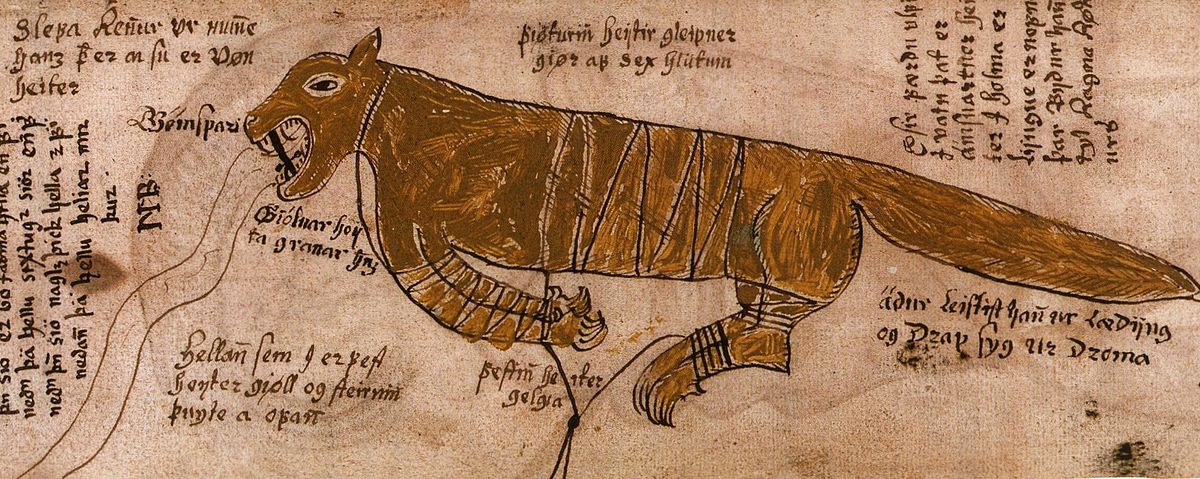
Pelevin supplies mythology around paradoxes to examine the difference in morality between Alexander and A Hu-Li. Pelevin first incorporates Norse mythology to explain the paradoxical nature of the super-werewolf’s creation. The super-werewolf is likened to Fenrir, the violent wolf who is foretold to swallow the sun and begin Ragnarök (Pelevin 114). However, this introduces its own paradox: Ragnarök, or the end of the world, can only begin when the wolf Fenrir consumes the sun, yet Fenrir cannot consume the sun until he is released at the start of Ragnarök (Pelevin 114). Like Fenrir, the super-werewolf is contained within a spiral seemingly without start, leading to both nirvana and the end of the world when A Hu-Li breaks through the paradox. This presents a challenge because if the super-werewolf is associated with Fenrir and A Hu-Li is the super-werewolf, then how does Pelevin distinguish A Hu-Li from the dread and doom surrounding Fenrir? However, Pelevin tethers Alexander to Fenrir as well as Garmr, seen through A Hu-Li’s inner dialogue about Fenrir as a “yellow-eyed monster” destined to “eat the gods when the northern project [is] shut down” (114). Pelevin therefore depicts Alexander—and by association, Big Oil—with the voracity of Fenrir, portraying the oil industry as an all-consuming beast that will never be satisfied and never end their atrocity.
Pelevin furthers his use of mythology to contrast A Hu-Li’s moral atonement with Alexander’s lack thereof. Throughout The Sacred Book of the Werewolf lays the motif of the Greek uroboros, a serpent biting its own tail to symbolize death and rebirth. A Hu-Li’s tail works the same way, arching over her head to create a circle symbolic of her deeper entanglement in the spiritual world. As another paradox intertwined so closely with A Hu-Li’s journey, the uroboros represents the loop of shame and atonement within which A Hu-Li is trapped before reaching nirvana, attainable only by breaking the cycle of life and death (Brown). Upon liberating herself from this circle, A Hu-Li is rebirthed as the super-werewolf, marking the success of her quest for moral atonement and righteousness. Meanwhile, Alexander remains stuck, both in old, traditional habits of thinking and in the body of a dog. Whereas he believes in atoning for sin, he does not work at moral achievement, perhaps even morally devolving from Fenrir to Garmr, as he has more wisdom yet refuses to change his line of work. In the note in which Alexander bids A Hu-Li farewell, he acknowledges A Hu-Li’s disapproval of the oil business but simultaneously assures her he will promote the wisdom she has given him to help his industry thrive (Pelevin 320). Pelevin's mythological and spiritual paradoxes mirror the real-world endless cycles of oil and avarice in which finding oil leads to greed and greed for oil leads to increased drilling and fracking. This circuit, taking human and environmental casualties alike, remains unbreakable unless lawmakers take action against Big Oil to forbid fracking and restrict the amount of pollution energy generation companies are allowed to produce (Shao). Pelevin demonstrates this through the allusions surrounding Alexander, indicating the moral corruption of both the character and the oil companies he represents.
Pelevin embeds fairy tales and mythology into The Sacred Book of the Werewolf to convey the corruption and horrors of the oil industry. The selected fairy tales are cross-cultural, incorporating not only Russian stories, but Norse and Greek allusions as well, demonstrating that the devastation caused by oil companies is a worldwide phenomenon. If to live is to suffer and breaking free of confining cycles is to reach enlightenment, then perhaps The Sacred Book of the Werewolf, while ranging in subject from prostitution to chicken hunting and philosophers to cinephiles, serves as a message of hope that one day the circle of suffering will end, and we will break free of the world of oil.
Bibliography
Brown, Waka Takahashi. “Introduction to Buddhism.” FSI, Stanford Program on International and Cross-Cultural Education, Dec. 2002, https://spice.fsi.stanford.edu/docs/introduction_to_buddhism#:~:text=C.-,Nirvana,cycle%20of%20death%20and%20rebirth.
Pelevin, Victor. “The Sacred Book of the Werewolf.” Translated by Andrew Bromfield, Penguin Group, 2008.
Perrault, Charles. “Bluebeard.” Folklore and Mythology Electronic Texts, Edited by D. L. Ashliman, https://sites.pitt.edu/~dash/type0312.html#perrault.
Shao, Elena. “What Would a Climate Emergency Mean? Here Are 4 Key Points.” New York Times, 21 July 2022, https://www.nytimes.com/article/climate-change-emergency-biden.html. Accessed 1 Aug. 2022.
This page has paths:
- Oil Texts José Vergara