River Volga Oil Paintings
Among Isaac Levitan’s (1860–1900) large collection of works exists a series of oil paintings centered around the river Volga. These paintings, visible below, share several common features of composition and focus. Among these elements are low saturated color schemes, a sense of heightened reflectiveness of the water, and a lack of individuals but an abundance of manmade objects, especially industrial boats such as the oil tankers of the day.
-----------------------------------------------------------------------------------------------------------------
The Volga river is one of the primary waterways in Russia, located in the western portion of the country and leads to the Caspian sea in the south. The river is also part of an incredibly large river system that connects to much of the region's waterways (Micklin). The Volga has a long history with humans and industry due to this centralization. It has been used as a means of transporting goods, including petroleum and oil based products.
Due in part to this industrialization of the Volga river, pollutants like oil have long found their way into the waterway. Oil spills and seepage were not uncommon in the late 19th and early 20th century, causing a host of issues for wildlife, public health and sanitation, and the communities whose lives and livelihoods relied on this water (Micklin).
Analysis of Levitan's Paintings as a Whole
--------------------------------------
Levitan’s paintings, although not completely obvious at first glance, explore the state of the Volga River during this time period and the emotional perception he and others had of the waterway. Despite the subtlety of Levitan's messaging, the landscapes' emotional evocations can be strongly felt in these paintings. This is, in part, thanks to the desaturation of the color palette present in most of these artworks, as well as the apparent lack of sunlight that comes along with these color schemes. These reflect the darkness that Levitan and others see when they consider what the Volga has become and in its future. A sense of hopelessness can be both seen and felt in these paintings. The desaturation also emphasizes a presentation of the Volga as dull, deathly, and lifeless (Costlow).
The spatial composition of Levitan’s paintings further emphasize the decay of the Volga due to oil. While meager nature borders the images, the central aspect of the works is the water itself. This focus is made manifest by the works' layouts, with the water of the Volga itself inhabiting large swaths of the image, often in a centralized position. This draws the audience's focus, both visually and mentally, on the water itself and the oil that sits upon it. Some of Levitan’s more vibrant images of the Volga (the word vibrant being used loosely), demonstrate a unique iridescence upon the water, a clear visual of the extent to which oil has infiltrated the river’s water.
Apart from the presentation of Levitan’s emotions through the mood of these paintings, these works also bring to attention the dehumanization and industrialization of the river. The vast majority of Levitan’s work with the Volga contains no human figures. Instead, the work focuses on various watercraft; oil barges and small abandoned boats along the shoreline. This acts as a means of demonstrating the dehumanization of the river and its subsequent industrialization (Costlow). The decision to include human machines but no humans themselves also further demonstrates the lifelessness of the late 19th century Volga from the perspective of Levitan. Interestingly enough, the discussion of human influences on the world through machinery even when humans are absent is not unique to Levitan's presentation of energy sources. Another work that focuses on these connections is Ray Bradbury's "There Will Come Soft Rains."
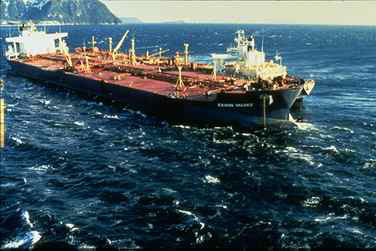
Some of Levitan’s paintings also are eerily similar in an artistic sense to photographs of the infamous 1989 Exxon Valdez oil spill ("Exxon"). The Exxon Valdez oil spill, being the largest oil spill for decades (until the Deepwater Horizon oil spill in 2010), is inextricably tied to human perception of oil pollution and the damage that it can cause to all facets of the environment and of life. In photographs after the spill, such as the image visible to the right, share several compositional elements to Levitan's paintings. The centralized aspect of the water, the fluids glossiness, and the focus on industrial elements like the Exxon Valdez oil tanker itself. These connections emphasize a sense of stagnation in the development of energy production methods. Although these images are around a century apart, they both contain common motifs involving the oil industry. The similarity between Levitan's paintings and the Exxon Valdez photographs also demonstrate our continued struggle, both as humans and as members of a broader environment and planet, with oil pollution since the fuel source's beginnings.
In-Depth Analysis of Isaac Levitan's "Dull Day at Volga" (1889)
----------------------------------------------------------------------------------------------------------
Isaac Levitan's 1889 oil painting "Dull Day at Volga" strongly demonstrates several of the characteristics previously discussed. The painting features, dull and dark colors, giving the piece a somber tone. The cloudy sky is filled with the gray blues that imitate the color of the smoggy byproduct that the oil industry pollutes the air with. The cloudiness of the painting also creates a dimness, both in the physical image but also in a more emotional sense; suggesting the brightness, liveliness and hopefulness of the river itself is becoming clouded by the overcast skies of mechanization and pollution. The Volga is, at this point, no longer able to fully be the beautiful and energetic central waterway of western Russia, only glimpses of this radiance are allowed to shine through. Looking down to the equally dull earth, the shores of the Volga are cast to the side of the painting; they are not the focal point. They are presented as bare, no life is visible on land, or anywhere in the piece for that matter. The river is rendered lifeless compared to what it once was (Costlow).
The small boats used by local fishers to support themselves and their families are no longer in use, rather they are left beached on the shoreline. They are of little use due to the damage the oil caused to local populations. Instead the watercraft in use are large oil barges, depicted as grim, shadowy figures by Levitan. The Volga has been mechanized and industrialized, and these large and looming images are undeniable evidence of this. There is a more extreme darkness in these barges that contrasts them against the landscape; bringing them into focus and forcing the audience to reckon with the changes that come alongside them. Finally, we come to the water of the Volga itself. It is vast in comparison to the other aspects of the painting, and its central location in the work's composition inevitably highlight it, suggesting further, deeper looks be taken into the water of the Volga itself. This is where the true interest, in the eyes of Levitan, lies. The surface of the water is much lighter than the majority of the painting, creating an unusual sense of shininess. This shininess resembles the appearance of oil on water, the same oil that has entered into the river as a result of industrial activity.
Final Words
-----------------------------------------------------------------------------
Levitan’s paintings of the Volga River give us a subtle yet uniquely powerful look into the ways in which oil seeps into our lives and the environment around us. Because of this, the works provide a look into our interplay with oil in a more metaphorical way. Just as Levitan's interpretations and emotions of the river's pollutions were disguised in the images of seemingly standard landscapes, so, too, do the impacts of oil and other energy sources loom under the surface of our day to day lives in ways unnoticeable until we look for them.
Bibliography
--------------------------------------------------------------------------------------------------------
Costlow, Jane. "Isaak Levitan and the Industrial Volga." Forthcoming. 1-26
“Exxon Valdez: Oil Spills: Damage Assessment, Remediation, and Restoration Program.” Exxon Valdez | Oil Spills | Damage Assessment, Remediation, and Restoration Program, 17 Aug. 2020, https://darrp.noaa.gov/oil-spills/exxon-valdez.
Micklin, Philip P. and Kuzin, Pavel Sergeyevich. "Volga River." Encyclopedia Britannica, 26 Dec. 2019, https://www.britannica.com/place/Volga-River. Accessed 1 August 2022.


This page has paths:
- Oil Texts José Vergara

Contents of this path:
- At Volga.- Isaac Levitan
- At Volga. Evening Falls.- Isaac Levitan
- Barges. The Volga. - Isaac Levitan
- Dull Day at Volga- Isaac Levitan
- Evening at Volga. - Isaac Levitan
- Fresh breeze. Volga. - Isaac Levitan
- Fresh breeze. Volga. - Isaac Levitan
- Landscape on Volga. Boats by the Riverbank- Isaac Levitan
- Volga, 1889 - Isaac Levitan
- Volga. A Calm Day. - Isaac Levitan