Akira
Introduction
Akira is the 1988 animated film adaptation of the eponymous manga by Katsuhiro Otomo. Born in Miyagi Prefecture on April 14, 1954, Otomo directly experienced birth and life in Japan post WWII. He grew up reading similar nuclear-inspired manga such as Astro Boy and Tetsujin 28-30. Both works featured a good-spirited nuclear-powered protagonist, inspiring him to comment on the historically pessimistic nature of nuclear weapons.
Summary
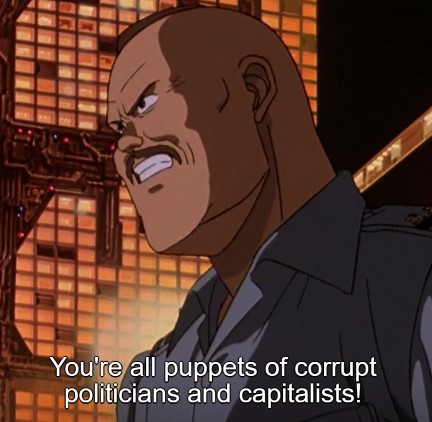
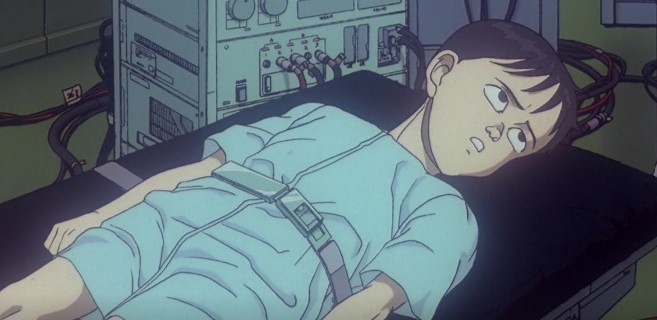
Tokyo, Japan, 1988. A serene map of the major city is shown, then immediately overcast by the black cloud of an atomic bomb, marking the start of World War III. Life post-bomb in that society, now rebuilt and renamed “Neo Tokyo” thirty years later, is chaotic. Corrupt government officials run the city. Student protestors and police officers come head-to-head over anti-imperialist demonstrations. Most of the city’s infrastructure is graffitied, damaged, and bloodied by rival bōsōzoku (biker) gang members, who now have claimed civilian streets as their home. Society's morals are influenced by the religious extremist group, the "Akira Awakening" movement, who believe that the atomic bomb was a God who ended the world because of humanity's sins, and that He will return to do it again. Among these biker gangs is Kaneda, a leader commanding low-ranking members such as Tetsuo. As they set off to fight the rival biker gang members, Tetsuo strays from the pack in an attempt to impress his leader. Simultaneously, in a nearby area of the city, the police are attempting to catch and quarantine a “psychic child," a victim of the 1988 Tokyo bombing. The anti-government organizer protecting him is brutally murdered by the police officers, prompting the psychic child to cause damage to the city and create an escape. Both this child and Tetsuo collide, and the former ultimately shields himself with his own psychic energy, knocking Tetsuo unconscious. Government officials retrieve the child and abduct Tetsuo to examine his injuries, but most importantly, examine potential radioactivity. They conduct a series of experiments on him.
At a secret government facility, a council of officials discuss the results of the experimentation: Tetsuo is now extremely dangerous, but potentially useful for the creation of nuclear weapons. However, Tetsuo manages to escape the facility, and begins a massacre of police officers, government officials, and bystanders who stand in the way of his pursuit for Akira, the fabled carrier of the energy which fueled the first atomic bomb. Tetsuo is now a feared, God-like figure — the nation's forces have all been directed to execute him, and the Akira Awakening movement sees him as a coming of the “second messiah." A God's fury knows no bounds, as demonstrated by Tetsuo's casual killing of his followers throughout their tirade, proving their prophecy correct.
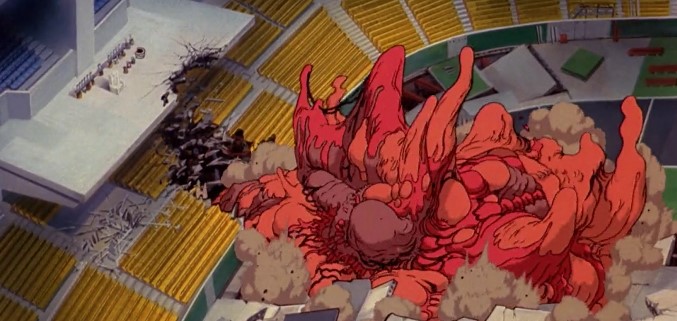
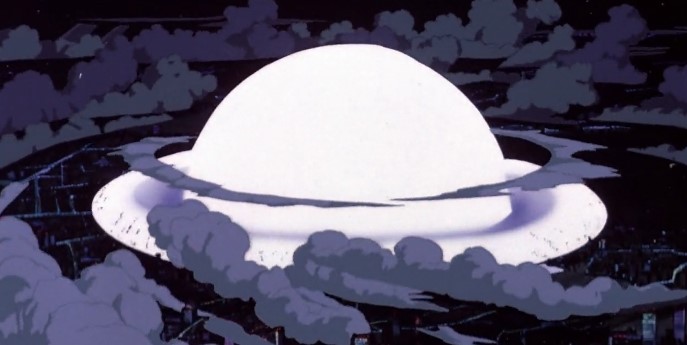
Losing his arm to the shot from an orbital weapon, Tetsuo demonstrates the ability to weave his human flesh with technology but is gravely wounded by the explosive resurfacing of Akira’s remains. Kaneda attempts to kill Tetsuo at his moment of weakness, while the psychic children appear praying to Akira’s remains. A flashback plays, showing life in Tokyo pre-Bomb; the psychic children were once housed in a government facility, where their powers were investigated in hopes of benefitting society. However, they were not able to, and thus the government used their energy to unleash the first atomic bomb. Returning to present-day neo Tokyo; when Tetsuo is shot by Kaneda, his body reacts by mutating in a mound of flesh that begins to destroy Neo Tokyo. Akira, witnessing the fall of Japan’s society due to another nuclear failure, sets off another atomic bomb, vaporizing and cleansing the universe anew.
Analysis
Nuclear energy is not inherently unsafe. Created by the contained splitting of uranium ions in a process called fission, it is generally a clean alternative to fossil fuels. What makes nuclear energy so fatal, however, is human involvement and greed. The Nuclear Anthropocene was the result of human greed and selfishness — a brutal means to an end which wiped out thousands of people, beings and societies in Hiroshima and Nagasaki at the conclusion of World War II.
In Akira, Otomo demonstrates that Capitalists have engineered the omnipotent "monster" that is Nuclear weaponry. Humans ultimately make the decision on how to harness this energy: “The thing about Akira’s power is it exists within everyone from the start. But when that power is awakened inside, it is important to wisely choose how to use it” (Otomo 01:17:18). The decision that ultimately influences the creation of nuclear weapons is manned by human greed: like an urge or impulse, there is a responsibility to act or abstain. However, humanity engineered the abilities in the psychic children, including Akira, in efforts to create a power which would benefit humanity in time of war. Thus, the weaponization of Akira’s energy offsets World War 3. Tetsuo’s own development into an “Atomic God” is entirely man-made as well; hours of experimenting exacerbates the damage endured by his body as he becomes humanity’s next nuclear weapon… but everything goes wrong.
When capitalism and imperialism discover something unprofitable, it is eviscerated, or cast aside. A government official during the secret facility meeting asks, “How much longer will you keep throwing away money on these worthless ghosts?” (Otomo 00:46:01). The usage of “ghosts” to refer to the victims of the first bombing showcases how little capitalism considers their independence as individuals. They are not people traumatized by the atomic bomb, but simple obstacles which represent living failures of greed, like broken toys. While a society may blame rampant crime or collapse on criminals, the homeless and other civilians, it is truly the fault of the government officials who have created the conditions for their suffering. Kiyoko, a first-hand witness of the disaster, emphasizes human misuse of authority: “Long ago, people tried to take control of that power. That is, all of the government’s requests. But they failed in their attempt, and it triggered the fall of Tokyo. And that power is something that is totally beyond our… ” (Otomo 01:13:12). Tetsuo is a manifestation of the grim reality of nuclear energy —an atomic potential that lives on inside each of us but can be engineered into something terrible—which has been weaponized by capitalism and imperialism to become the world’s ender.
The fear inspired by the initial atomic bomb has stirred a God-like fear for nuclear weapons. The "Akira Awakening" movement knows that the bombing was powered by a person's atomic energy; Akira, one of the several psychic children experimented on by the government. For the thirty years leading up to 2019, the movement had been teasing a return of this power - that humanity must now repent for the evil, corruption and degeneration of society with their blood. Tetsuo's development as a failed nuclear weapon, causing mass-destruction to the city of Neo Tokyo, reminds the movement of Akira, and thus the Christian concept of the "Second Resurrection" is referenced. Shortly before his death at the hands of Tetsuo, the leader of the movement exclaims, “Give yourself to the flame, children, and all of you shall be reborn again! Now consume our heart, wash our unclean hearts in the eternal fire!” (Otomo 01:24:34). “Fire” and “flame” is repeated here, referencing nuclear flammability and explosions, but also as an allegory to "fate" and "death". It t is used specifically to cite the sacrifices made by the initial victims of the 1988 atomic bomb, in an explosion which gave “birth” to the present society of Neo Tokyo, creating the image of the realistically violent Christian God who rained plagues of flame upon the world as a consequence to humanity.
Nuclear power, for all its proven and potential benefits to humanity and the planet Earth, is still largely misunderstood and unexplored. Nearly eighty years following the bombings of Hiroshima and Nagasaki and thirty years after the theatrical release of Akira, nuclear fusion, a much safer and environmentally friendly usage of nuclear energy, is actively being researched and may not be implemented for decades to come. Similarly, the effects of a nuclear weapon on humankind are also less researched, but actively demonstrated as something to fear; the physical, mental, and social effects of the bomb last generations, as does the lifespan of radioactivity showcased by the affected organisms and society of the Chornobyl Power Plant in Ukraine since April 1986. This lack of understanding, yet great fear of the power, is reflected in the reasoning behind religions' existence today. Religion was crafted by man to give an explanation for the unexplainable about society, to set moralistic guidelines, and to remind humanity of their inferiority to some aspect of the universe. Nuclear energy fulfills all these qualifications; it lacks understanding, it challenges the concept of greed, and reminds humanity that we are not powerful enough to fight against radioactivity, but powerful enough to use this energy appropriately.
The dangers demonstrated by nuclear power show its omnipotent force; thus, nuclear power is its own religion. However, it is a religion that has been manufactured for human benefit. The government describes their role in engineering the nuclear God, Akira, “There is your messiah, the chosen that you’ve been looking for. Not long after his transcendental awakening, his organs and tissues were subjected to every test known to modern science” (Otomo 1:31:31). Akira’s power has been studied for the benefit of humanity, and his organs have been preserved to commemorate his unique tragedy but to better benefit humanity.. Capitalist society has retained artifacts from major disasters - in Akira, this is the preservation of his remains, and in real life, this is the preservation of events such as the WWII bombings on Japan - to remind itself of its failings, but most importantly, to understand how to create safer inventions from nuclear energy. The omnipotent power of Akira reminds us of the possibilities that await us if we use atomic energy for evil; for greed; for capital by creating nuclear weapons.
Conclusion
Nuclear energy is a man-made religion, with humanity acting as Moses and John writing the Bible—or better put, manual—depicting its power and the lessons to be learned from the tragedy. Capitalism and imperialism are extensions of human greed, and nuclear potentiality, as exemplified by Tetsuo and Akira’s individual trajectories, are consequential of their economic uselessness. Today’s society is a cesspool of capitalism, imperialism, creating a hunger for cannibalistic human evisceration. Otomo’s perception of life following nuclear disaster, crafted from his childhood spent in post-WWII society, is a testimony to the mass destruction which greed has caused, and the weapons we no longer have control over.
Bibliography:
Otomo, Katsuhiro. Akira. Streamline Pictures, 1988.
This page has paths:
- Nuclear Texts José Vergara
